

Blog
What Credit Score Do You Need to Finance an Engagement Ring?


Most buyers ask the credit-score question after they have already found the ring. They have the style, the center stone, the price, and the proposal timeline locked in. Then the financing page loads, and the real question shows up: “What score do I need to get approved?”
There is no single engagement-ring financing score requirement. Store credit cards, bank-issued promotional plans, buy-now-pay-later providers, lease-to-own programs, and no-credit-check jewelry financing each use a different approval model. Some lean hard on your credit score. Some run a soft review. Some skip the credit check entirely at application.
Below: what score ranges typically mean, how traditional engagement-ring financing evaluates buyers, what happens if your score is fair, poor, or nonexistent, and how the MJC Card from Monetary Jewelers fits buyers who want application-based jewelry financing.
The short answer: it depends on the financing type
For a traditional jewelry-store credit card or bank-issued promotional plan, a stronger credit score usually means better approval odds and a larger credit line. Buyers in the Good, Very Good, or Exceptional bands are typically easier for a bank to approve than buyers with recent late payments, collections, or a short credit file.
For buy-now-pay-later, the provider may run a soft inquiry or use alternative data like account history, repayment behavior, and debit-card activity. Approval is often easier than a bank card, though the credit-history benefit is usually thin or nothing.
For lease-to-own or rent-to-own, approval may not hinge on a traditional credit score at all because the contract is structured as a lease, not a credit account. That solves the approval problem but changes the total cost and the credit-reporting value.
The MJC Card uses application-based eligibility. The program requires application review and may furnish payment activity to major credit bureaus.
What credit score ranges mean
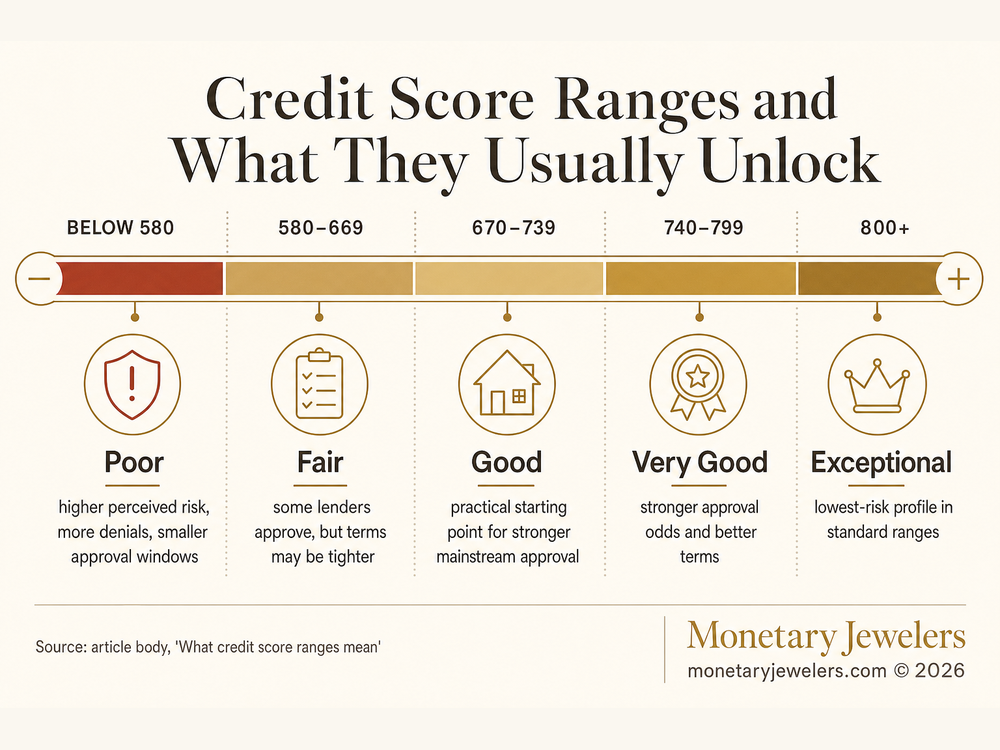
Most consumer credit scores run from 300 to 850. myFICO’s credit-score education describes the common FICO Score bands this way:
| Score range | Common label | What it usually means to lenders |
|---|---|---|
| Below 580 | Poor | Higher perceived risk, more denials, smaller approval windows |
| 580-669 | Fair | Some lenders approve, but terms may be tighter |
| 670-739 | Good | Often the practical starting point for stronger mainstream approval |
| 740-799 | Very Good | Stronger approval odds and better terms |
| 800+ | Exceptional | Lowest-risk profile in the standard ranges |
Those bands are useful but not a guarantee. Every lender sets its own cutoff, and jewelry financing is not a single market. A bank-issued store card, a point-of-sale lender, a lease-to-own provider, and an in-house jewelry card can all look at the same buyer and reach different decisions.
A score by itself also misses context. A 665 with two years of clean payments often looks better to a lender than a 690 with a missed payment last quarter. A 720 with maxed-out cards may still trigger a smaller credit line than expected. A buyer with no score may get declined by a bank model even with stable income and enough cash flow for the monthly payment.
Why traditional jewelry financing can be hard with fair or poor credit
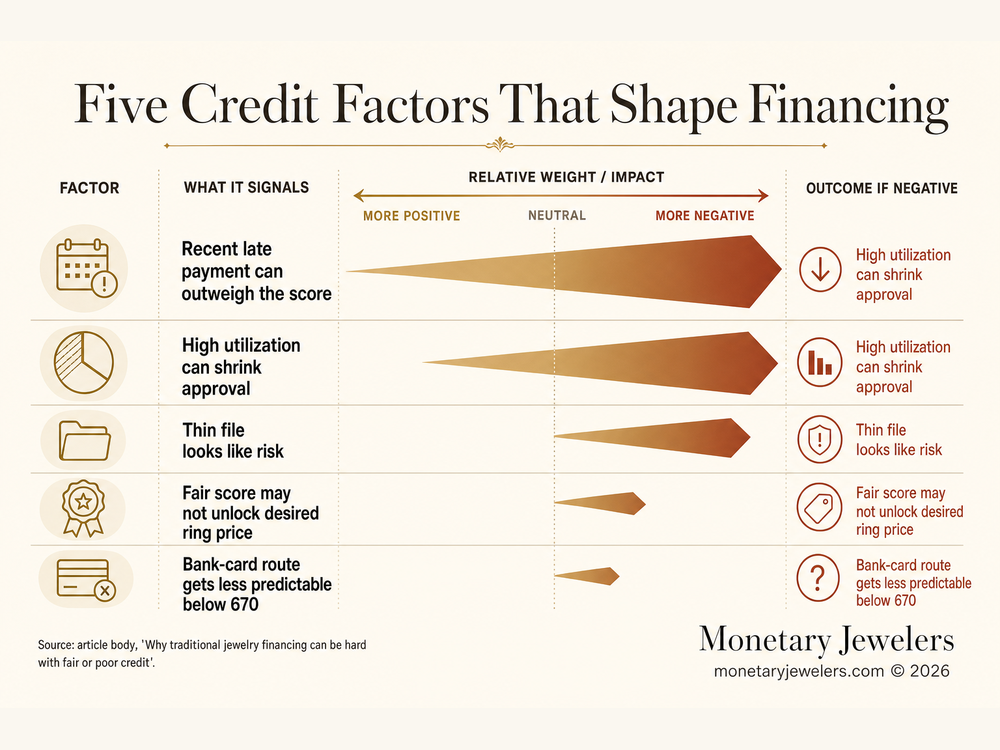
Traditional jewelry-store credit is built around a bank’s risk model. The lender wants evidence that you have borrowed before, paid on time, kept balances under control, and avoided recent derogatory marks.
A few patterns trip up engagement-ring buyers in particular.
A fair score may not unlock the ring price
Even when a lender approves a fair-credit buyer, the credit line can come in below the ring’s price. A $1,000 approval does not solve a $3,000 purchase unless cash covers the rest.
A recent late payment can outweigh the score
Recent payment history tells the lender what is happening now. A 30-day late from last month usually weighs heavier than an older mistake followed by clean months.
High utilization can shrink approval
If your existing cards are close to their limits, the lender sees less headroom for another payment. That can drag approval down even when the score itself is fine.
A thin file looks like risk
No credit and bad credit are different problems, but a bank model often struggles with either. With too little history, the lender has nothing to score against.
The credit-pull problem
The application itself counts.
myFICO explains credit inquiries in two categories: soft and hard. A soft inquiry does not affect your FICO Scores. A hard inquiry, the kind tied to applying for a new loan or credit card, can.
One hard inquiry is rarely a disaster. myFICO notes that an additional inquiry usually takes less than five points off a FICO Score. But if your score is hovering near a lender’s cutoff, or your file is short, even a small dip changes the outcome. Multiple applications across several stores in a short window can also make the search read as riskier than it needs to.
That is the appeal of a true no-credit-check application: you can see whether you have an option without putting an inquiry on file.
Comparing engagement-ring financing options by score pressure
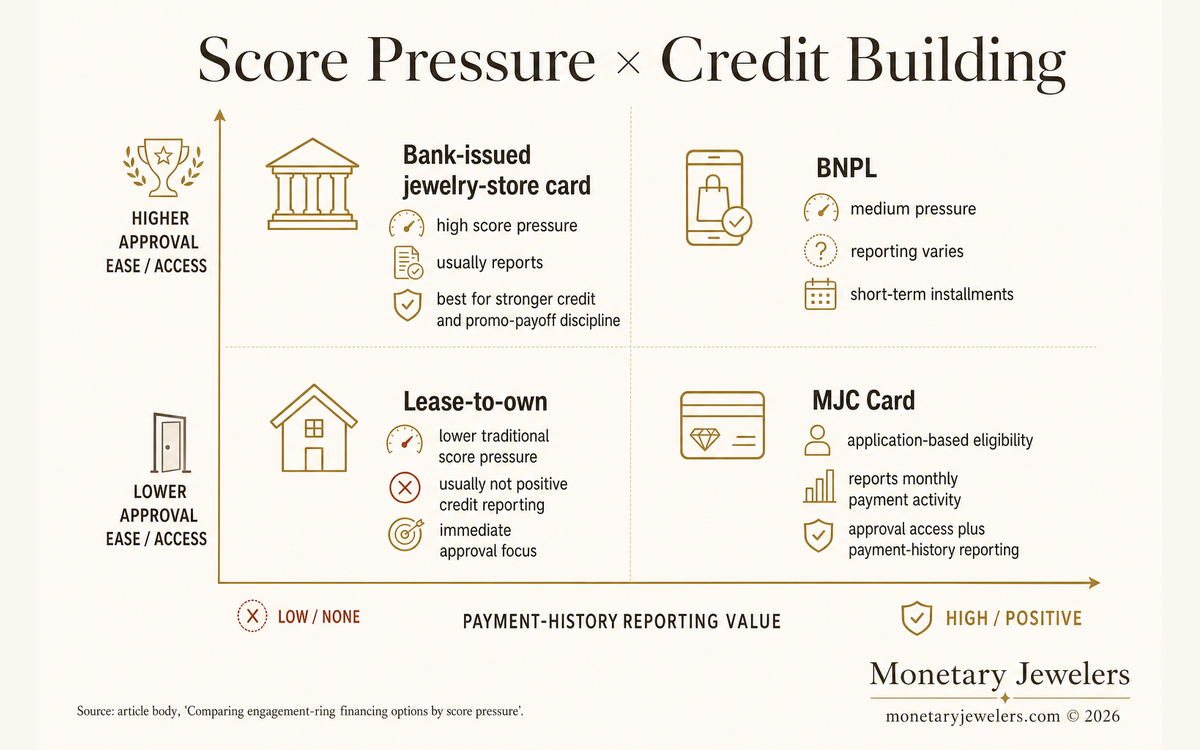
Use this table as a practical starting point:
| Financing type | Score pressure | Application impact | Payment reporting | Best fit |
|---|---|---|---|---|
| Bank-issued jewelry-store card | High | Often hard inquiry | Usually reports | Buyers with stronger credit and promo-payoff discipline |
| Buy-now-pay-later | Medium | Usually soft review or alternative review | Varies by provider/product | Buyers who want short-term installments |
| Lease-to-own | Lower traditional score pressure | Often no traditional credit check | Usually not positive credit reporting | Buyers focused only on immediate approval |
| No-credit-check reported revolving account (MJC Card) | Application-based eligibility | Application-based eligibility | Reports monthly payment activity | Buyers who want approval access plus payment-history reporting |
Pick based on what you are solving. Strong credit plus the discipline to clear the balance before a deferred-interest deadline favors a bank promotion. Fast approval with no concern for credit reporting points to BNPL or lease-to-own. Wanting to skip the credit check while still building reported payment history is the lane the MJC Card was built for.
What if your score is below 670?
A score below 670 does not lock you out of engagement-ring financing. It does mean the traditional bank-card route gets less predictable.
In the Fair range, approvals still happen, but the credit line may run smaller, the APR may run higher, or the promotional terms may be weaker. Below 580, denials are common through traditional credit-card-style financing. With a thin file or no score, the issue is often missing data rather than negative history. The lender simply does not have enough to work with.
That is where financing structure outweighs the score itself. A no-credit-check application evaluates the buyer without pulling the credit file. A reported account then builds payment-history value after approval, provided payments come in on time.
How the MJC Card handles the score question

The MJC Card takes the traditional score gate off the application.
There is application-based eligibility. The program requires application review. Approval looks at identity, income, and bank-account history rather than using a credit score as the entry ticket.
Post-approval terms are published up front:
- 34% down
- 19.90% APR
- Minimum monthly payment of 7% of the original amount financed or $50, whichever is greater
- No early-payoff penalty
- Monthly payment activity is reported monthly to credit bureaus
The account does two jobs at once: it gets the ring and builds reported payment history. It is still credit, so late payments hurt. The value depends on choosing a ring price and monthly payment that fit the buyer’s budget.
How much ring can you finance responsibly?
The score question is the wrong starting point. A better one: “What monthly payment can I carry without strain?”
Use the engagement-ring monthly payment guide for worked examples. On MJC Card terms, a $2,000 ring with the 34% down payment leaves $680 down and a $1,320 financed balance. The fixed minimum payment would be 7% of the original amount financed, about $93. Paying more than the minimum reduces total interest and shortens the payoff window.
That math matters more than chasing the largest possible approval. A responsible plan leaves room for rent, car payments, insurance, groceries, savings, and the proposal itself.
A five-step plan before you apply
Before submitting any engagement-ring financing application:
-
Check the application type. Ask whether it is a hard pull, soft pull, or no credit check.
-
Ask what kind of contract it is. Credit account, lease-to-own, BNPL, and store card are not interchangeable.
-
Confirm payment reporting. If you want the account to help your credit history, ask whether on-time payments are reported to the credit bureaus. This which jewelry financing accounts report to credit bureaus guide explains what to verify before you apply.
-
Run the monthly payment. Use the down payment, APR, and minimum-payment formula, not the sticker price.
-
Pick the ring after the payment works. The right ring is the one you can buy without putting the rest of your finances under pressure.
For a deeper comparison of approval language, read the no credit check vs. no credit needed jewelry financing guide. For the wider no-credit-check store market, see the jewelry stores that do not check credit guide. If the goal is using jewelry financing to build payment history, start with how jewelry financing can build credit.
Bottom line
No universal credit score is required to finance an engagement ring. A strong score helps with traditional store cards and bank promotions, but it is one path among several.
If your score is fair, poor, thin, or nonexistent, stop guessing the cutoff and start reading the financing structure. Does it pull your credit? Does it report payments? What is the total cost? Can you pay early without penalty? Does the monthly payment fit your real budget?
The MJC Card is built for buyers who want to apply through an application-based eligibility path and may have payment activity furnished to major credit bureaus after purchase. It works when the ring is the immediate need and the credit-history plan is the next one.
How to choose the next path from your score situation
Use your credit-score situation to pick the safest next step instead of the fastest approval button.
| Your situation | Main risk | Practical next step |
|---|---|---|
| No score or thin file | Approval options may not create useful payment history. | Start with the thin-file jewelry payment guide. |
| Recent denial | Stacking more applications can add pressure without solving the cause. | Read the after-denial guide before applying again. |
| Damaged score but stable income | A payment that is too large can create a new late-payment problem. | Compare ring prices against the monthly payment math. |
| Ready to shop | Choosing the ring before understanding the payment can stretch the budget. | Browse engagement and wedding rings after setting the payment ceiling. |
Frequently asked questions
What credit score do you need to finance an engagement ring?
There is no single required score. Traditional jewelry-store cards often favor Good credit or better, while BNPL, lease-to-own, and no-credit-check programs use different approval models. The MJC Card from Monetary Jewelers uses application-based eligibility and requires application review.
Can I finance an engagement ring with bad credit?
Yes. Bad credit can make traditional bank-issued store cards harder, but it does not remove every option. No-credit-check jewelry financing can evaluate income, identity, and bank-account history rather than using your credit score as the approval gate.
Does applying for engagement-ring financing hurt your credit?
It depends on the application. A hard inquiry can affect your score. A soft inquiry does not affect your FICO Scores. A true no-credit-check application avoids a credit inquiry at application.
Can engagement-ring financing build credit?
Only if the account reports payment activity to the credit bureaus. The MJC Card may furnish payment activity to major credit bureaus, so on-time payments can support payment history over time.
Is no credit the same as bad credit?
No. No credit usually means there is not enough history for a lender to score or evaluate confidently. Bad credit usually means the file has negative marks, high utilization, late payments, collections, or other risk signals. Both can make traditional approval harder.
What is the easiest way to finance an engagement ring with no credit check?
Look for a program that clearly says there is application-based eligibility, explains the payment terms before you sign, and states whether payment activity is reported. The MJC Card is one option built around those requirements.
When you are ready to shop, see the best engagement rings for bad credit.