


Blog
Diamond Stud Earrings: Sizes, Settings and Shapes Explained

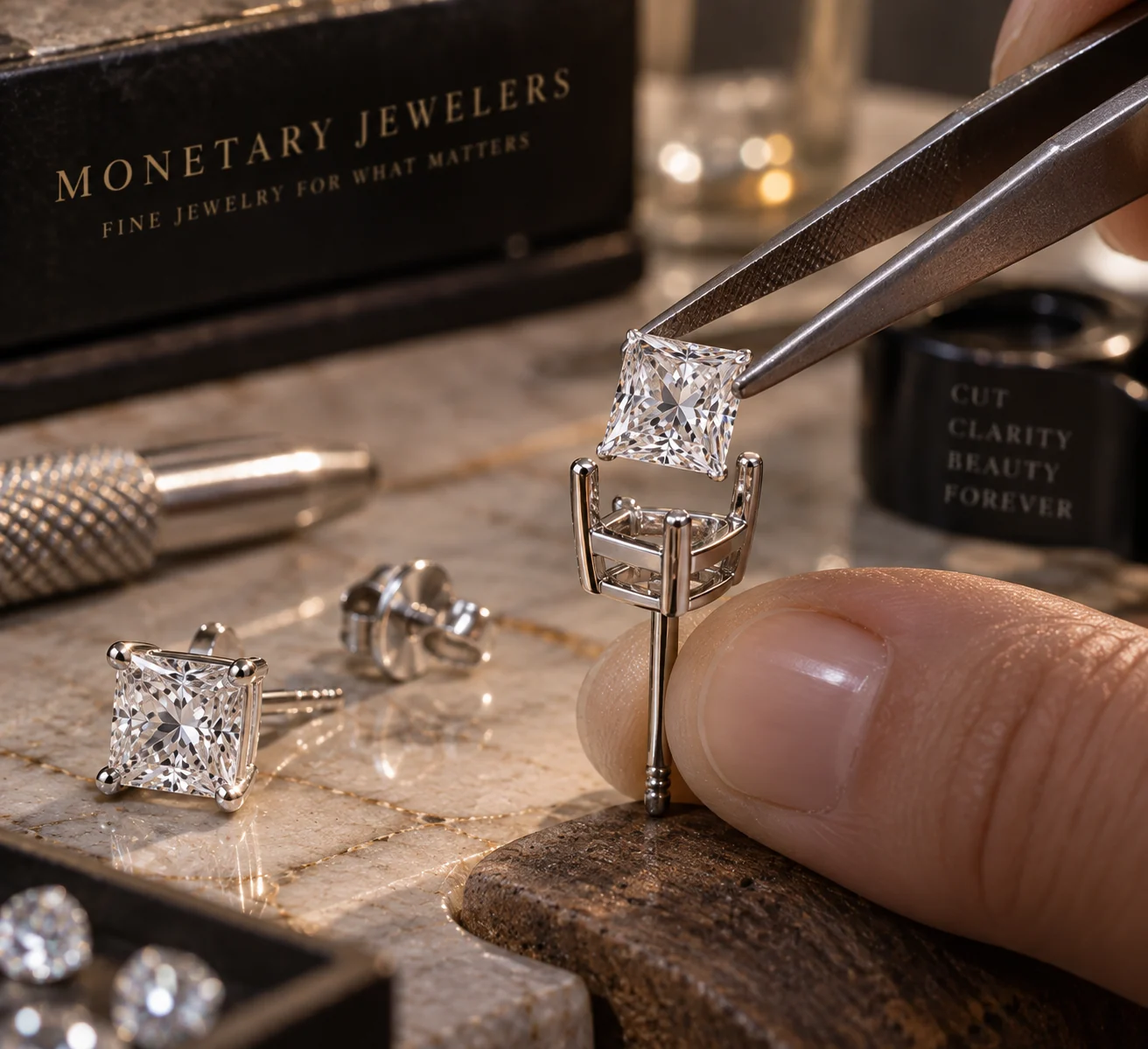
The most-worn piece of fine jewelry most people own — and the one most often bought at the wrong size, because the carat weight on the label is the weight of both diamonds together.
Diamond studs are the most-worn piece of fine jewelry most people own. They go on in the morning and stay on — through work, the gym, sleep, showers. That changes what matters when you buy them. A ring gets admired; studs get lived in.
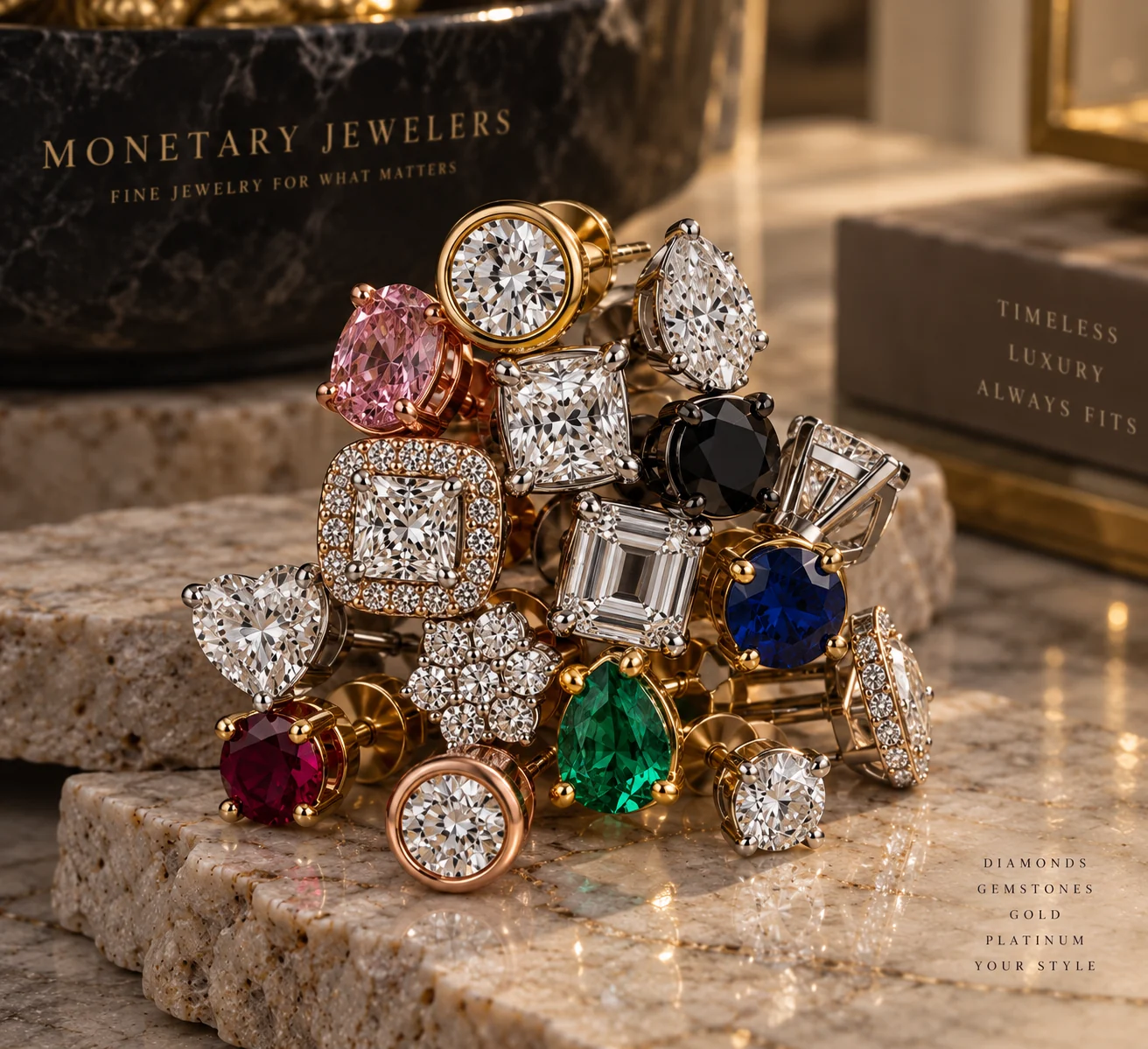
This guide covers the whole category: how sizing actually works, what each weight looks like on an ear, the settings and closures, diamond shapes, colored diamonds, colored gemstones and metals. Some of it describes pairs we keep in stock. A good deal of it describes pairs we would make to order.
The sizing mistake almost everyone makes
Stud earrings are sold by total carat weight, written as “ct tw” or “cttw.” That figure is the weight of both diamonds added together — not the weight of each one.
So a 1.00 ct tw pair is two half-carat diamonds. A 2 ct tw pair is two 1-carat diamonds. Our 6 ct tw studs are 3 carats in each ear.
Someone searching for “1 carat diamond stud earrings” is often picturing a 1-carat stone in each ear — which is a 2 ct tw pair, and roughly double the diamond. Rings are the opposite, which is where the confusion starts: a 1-carat engagement ring means a 1-carat center stone. Earrings come in twos, so the trade quotes the pair. Check you are comparing the same measurement before you compare the price.
What each size actually looks like
Carat is weight, not width. What you see on an ear is the diameter of the stone’s face. For round brilliant diamonds those measurements are consistent enough to plan around, though they are approximations — two diamonds of identical weight can measure differently face-up depending on how they are proportioned.
Here is the translation, with total weight on the left and the approximate diameter of each individual stone on the right. The last row, 7 ct tw, remains a custom order in round; some fancy-shape studs in our current collection are available at higher total weights.
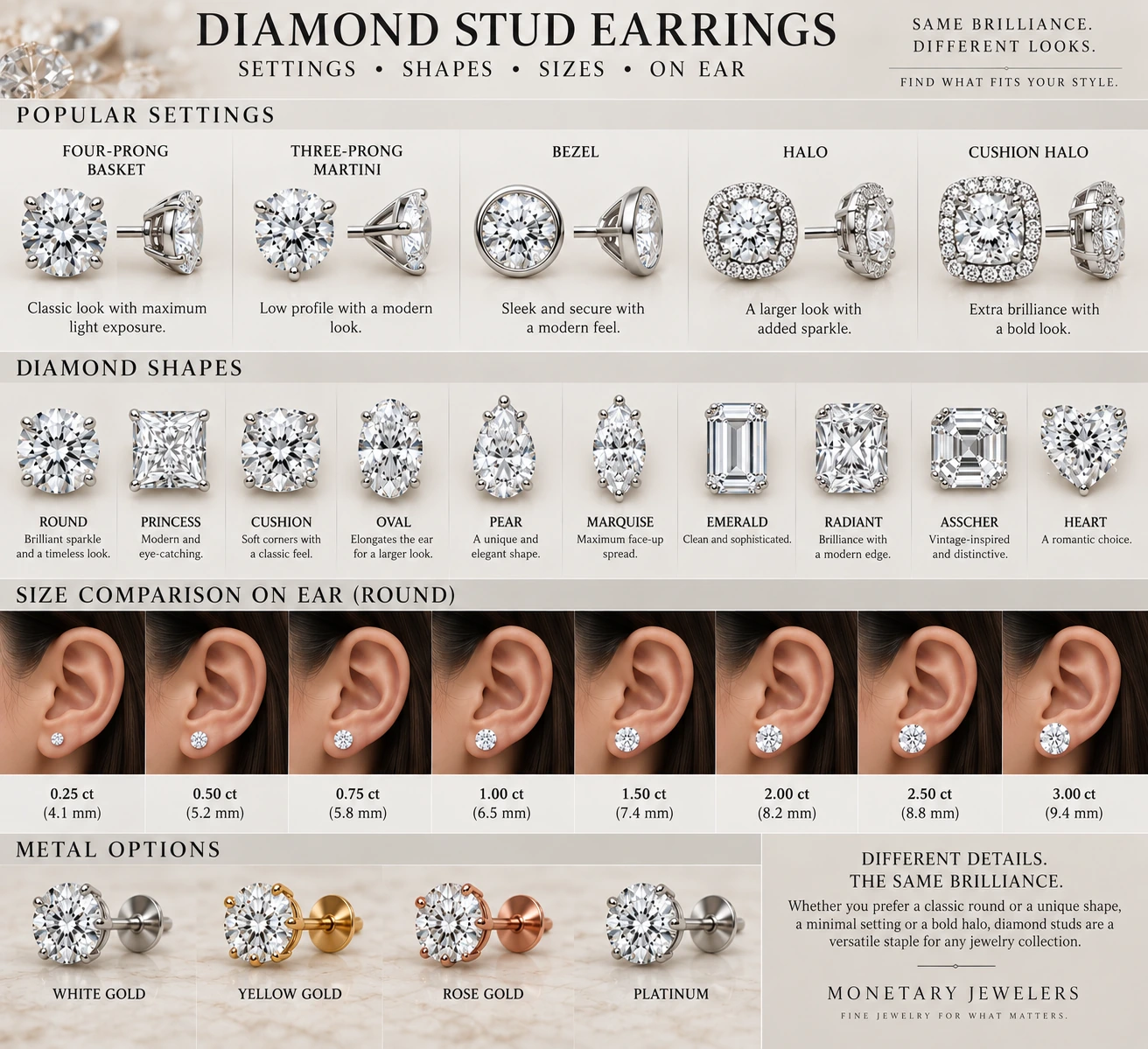
Diamond stud earring size chart: carat weight to millimeters
| Total weight (pair) | Each diamond | Approximate diameter per stone |
|---|---|---|
| 1/2 ct tw | 0.25 ct | about 4.1 mm |
| 1 ct tw | 0.50 ct | 5.1 to 5.2 mm |
| 1.5 ct tw | 0.75 ct | about 5.8 mm |
| 2 ct tw | 1.00 ct | about 6.5 mm |
| 3 ct tw | 1.50 ct | about 7.4 mm |
| 4 ct tw | 2.00 ct | about 8.2 mm |
| 5 ct tw | 2.50 ct | about 8.8 mm |
| 6 ct tw | 3.00 ct | about 9.4 mm |
| 7 ct tw | 3.50 ct | about 10.0 mm |
On the ear, those millimetres are what you actually see. A 1 ct tw pair sits just over 5 mm across on each lobe, 2 ct tw is about 6.5 mm, and 4 ct tw and up reads as a statement at 8 mm or more. The same stone also looks larger on a smaller earlobe, which is why two people can wear the same carat weight and get a different effect.
Notice how slowly the width grows. Going from 1 ct tw to 2 ct tw doubles the diamond weight, but the visible diameter only increases from roughly 5.1 mm to about 6.5 mm per stone — a little over a quarter wider. Weight climbs with volume, which is three-dimensional; width is a single measurement. That is why the jump from a half carat to a full carat per ear looks far less dramatic than the difference in weight suggests.
It also works in your favor at the small end. A 1/2 ct tw pair at roughly 4 mm per stone still reads clearly as diamond studs from across a table.
Everyday or statement
As a rough guide, 1/4 to 1 ct tw is the everyday range — small enough to sleep in and wear with anything. 1 to 2 ct tw is where studs start getting noticed and still work in daylight. Above that you are into statement territory, and above 4 ct tw the weight of the earring itself becomes a consideration for how it hangs in the lobe.
Two things affect this more than people expect. Ear size: the same 8 mm stone reads larger on a small lobe. And hair: studs worn with hair pulled back are far more visible than the same pair under loose hair.
If you can, try two weights on before deciding. In our experience, customers who come in certain they want the largest option often settle one step down, and customers who ask for something discreet often end up one step up.
Settings: how the diamond is held
The setting decides how much metal you see and how high the diamond sits off the lobe. On studs, the setting affects not only how the diamond looks but how securely it sits on the ear and how easily it catches on clothing, towels or bedding. Actual height and security depend on how a particular earring is constructed, so treat the descriptions below as general tendencies rather than fixed rules.
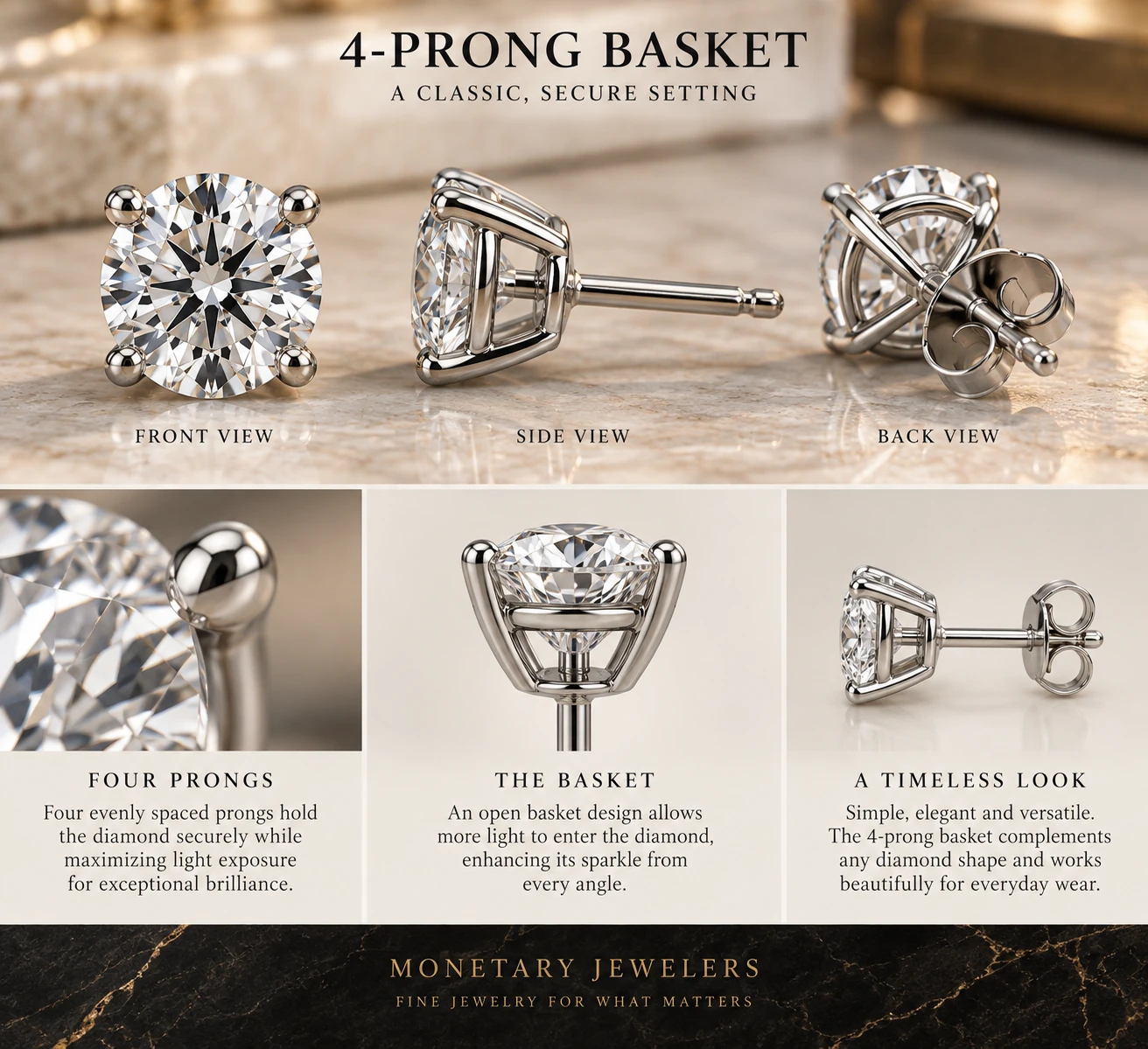
Four-prong basket
The classic. Four prongs hold the stone in a small basket, leaving most of the diamond exposed from the sides as well as the top. Light gets in from more directions, and the stone reads at close to its full outline.
It typically sits a little higher off the lobe than a bezel or a martini. Prongs are the part to keep an eye on over the years — have them checked when you have the earrings cleaned.
Three-prong martini
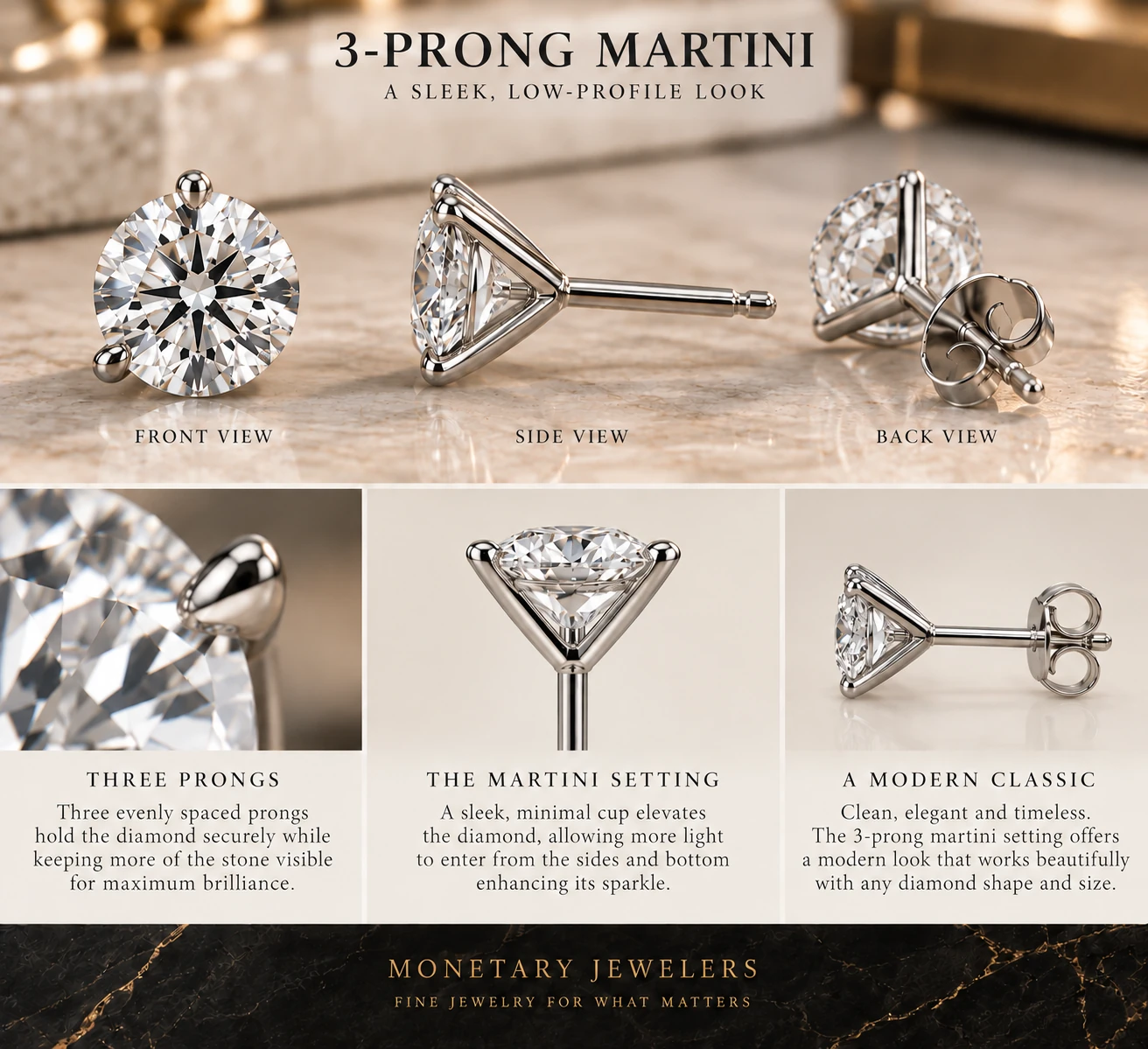
Three prongs in a cone shape, named for the glass it resembles. This is a low-profile setting, so the earring tends to lie flatter against the lobe and is less likely to catch or rotate forward.
With one fewer prong than a traditional four-prong basket, the setting should be checked periodically to make sure the prongs remain tight. A well-made martini is a perfectly sound choice for a stud — it simply rewards a little maintenance attention.
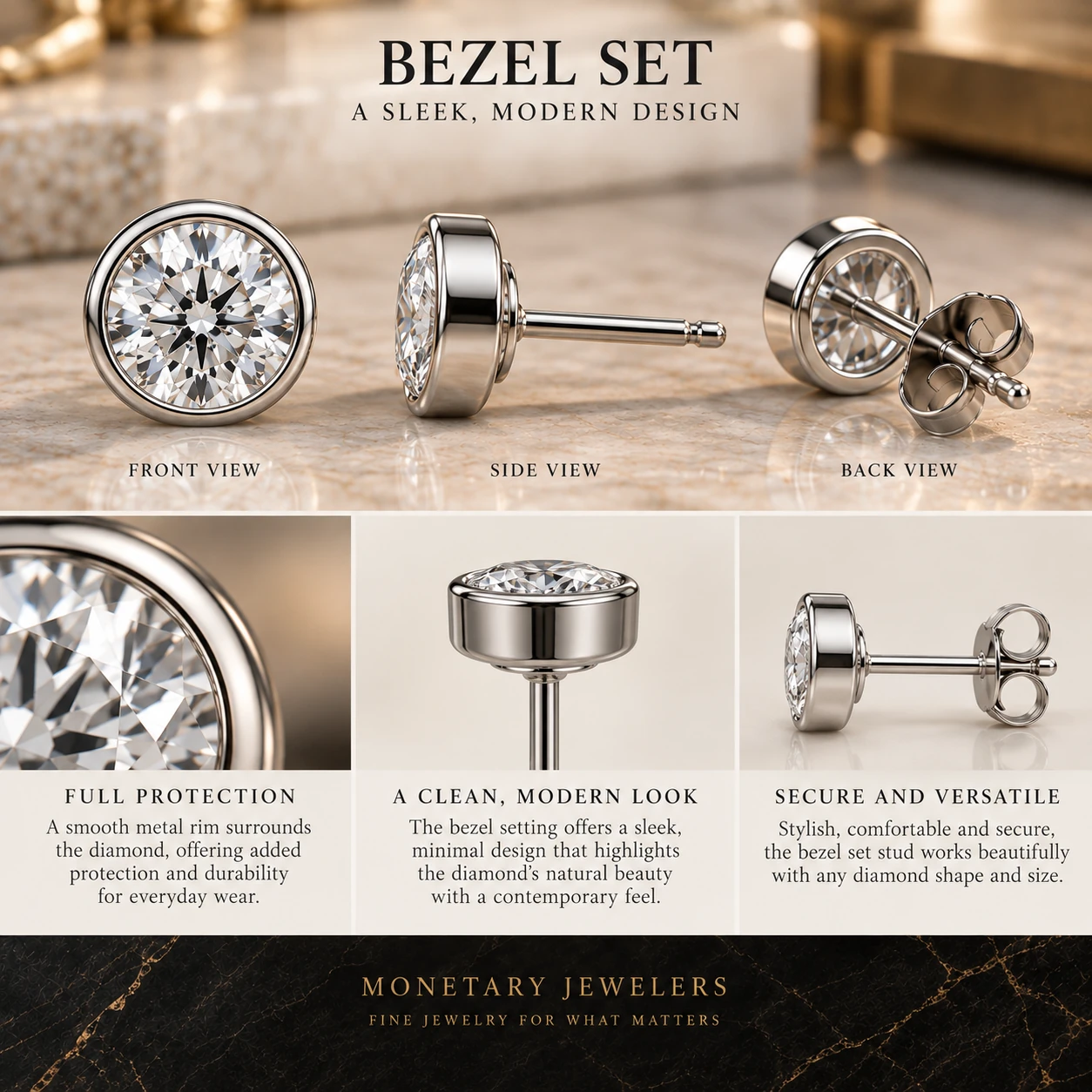
Bezel
A continuous rim of metal wraps the whole edge of the diamond. A bezel is one of the most protective settings for a diamond, because metal surrounds its girdle rather than gripping it at points, and it is a low-profile setting — there is little sticking out to snag on a scarf, a towel or a pillow.
You see more metal and slightly less diamond, and the rim can make the stone read marginally smaller than the same weight in prongs. For anyone who works with their hands, has small children, or simply never takes earrings out, we think that is usually a trade worth making.
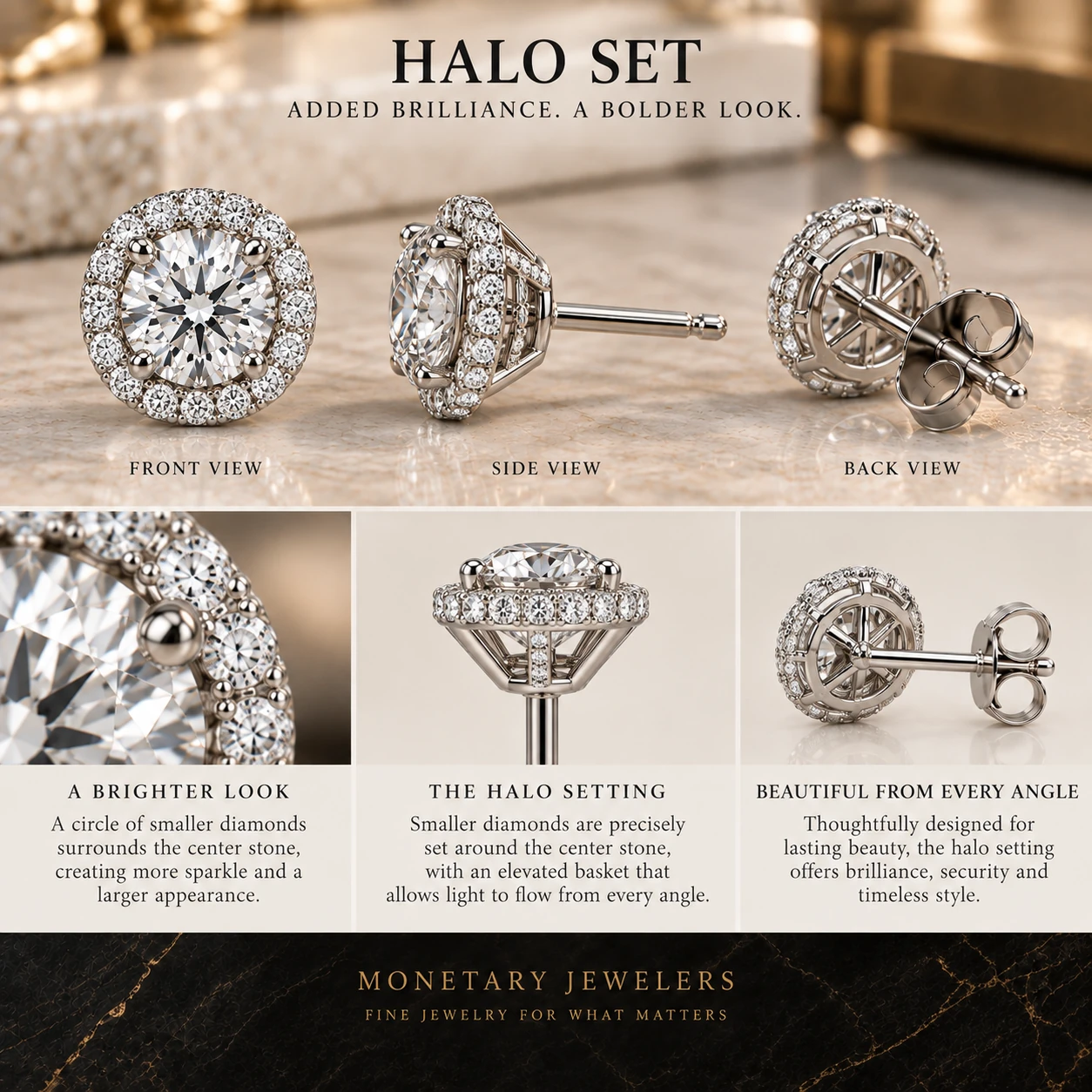
Halo
A ring of small diamonds circles the center stone. A halo increases the overall face-up spread of the earring, which gives a smaller center diamond noticeably more presence on the ear. A hidden halo places the small diamonds beneath the center stone instead, so from the front the stud can read more like a solitaire while the extra sparkle appears from the side.
More stones means more prongs and more setting work, so look closely at the small diamonds: they should match each other in color and sit evenly. Halos are also wider overall, which tends to read as dressier.
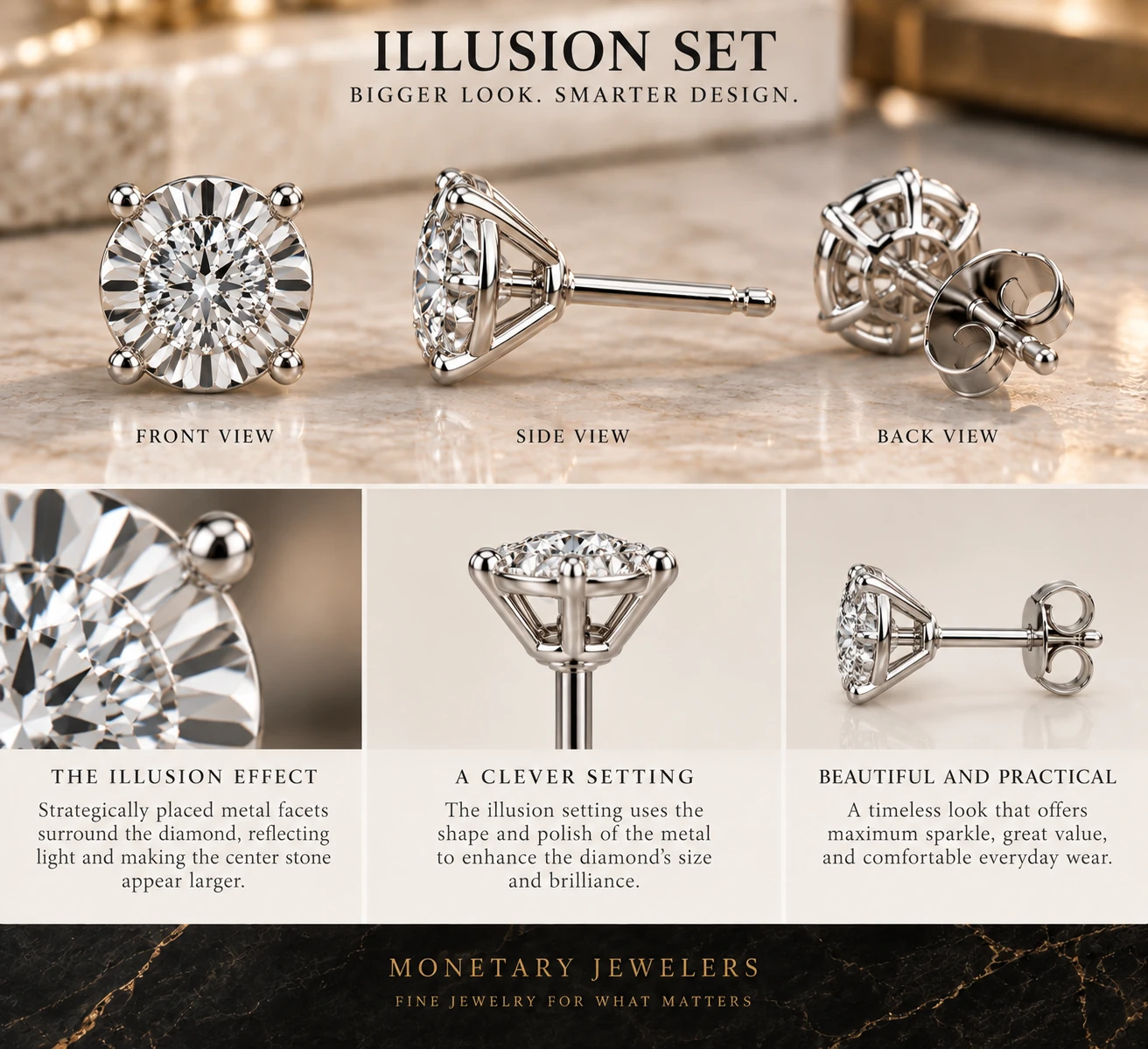
Illusion
The metal around the stone is shaped and polished to extend the visual outline, so a smaller diamond looks larger than it is. Useful when you want presence without putting the whole budget into carat weight. The diamond has not changed size; the metal is doing part of the work.
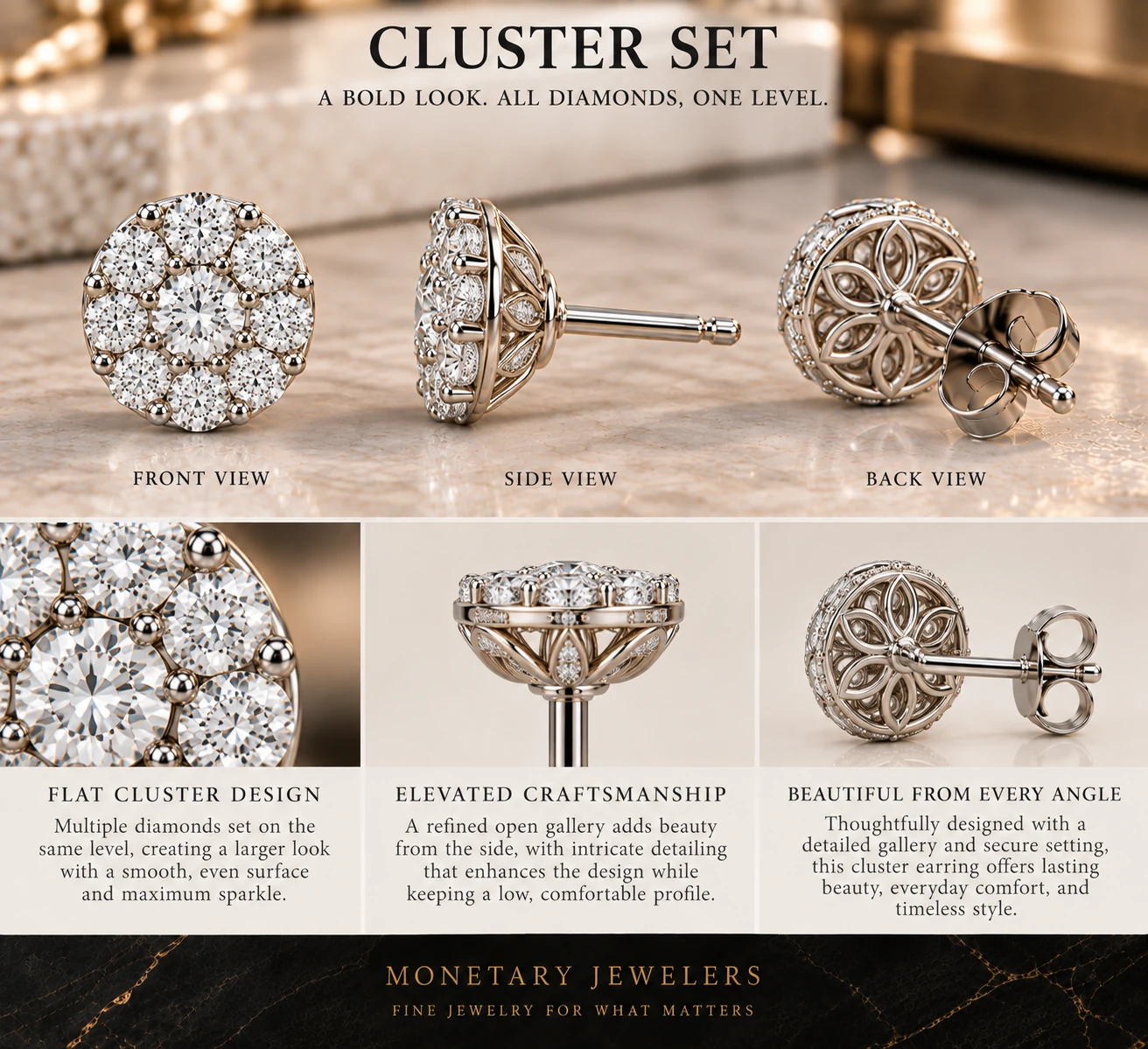
Cluster
Several small diamonds set together so the group reads as one larger stone. Because small diamonds generally cost far less per carat than large ones, a cluster is one of the more economical ways to get visible size. The look is different — you see the individual stones rather than one large facet pattern — but at conversational distance the effect is size.
Our natural diamond fashion earrings are built mostly this way, which is what keeps natural stones affordable at visible size.
Earring backs: the part that loses diamonds
People spend weeks choosing a diamond and no time at all on the back that keeps it attached. The earring back is easy to overlook, but it plays a major role in keeping a stud secure.
Push backs
Also called friction backs. A small butterfly clutch slides onto the post and grips it. Fast on, fast off, and less bulky than many locking backs. The grip can loosen with use, and a loose push back is how an earring ends up on the floor of a taxi, so replace a push back when it no longer holds the post firmly.
Screw backs
The post is threaded and the back screws on. More secure than friction, and the usual recommendation for anything you would be upset to lose. The tradeoff is time — they are slower to put on and take off, and the threads can wear if you cross-thread them repeatedly.
Many of the studs in our collection are offered with a choice of push back or screw back closures. For higher-value pairs we generally recommend screw backs for the added security.
Locking backs
A hinged mechanism that clicks closed around the post. More secure than friction and quicker than screwing, which makes them a genuine middle ground. They are bulkier behind the lobe, which some people notice when sleeping.
Diamond shapes
Round brilliant is the default for studs, but it is far from the only option, and shape changes apparent size at identical weight. Elongated shapes tend to spread further across the lobe than compact ones.
At one carat per stone, a well-proportioned round is about 6.5 mm in diameter. Fancy-shape dimensions vary more, because their length-to-width ratios and depths can differ considerably from stone to stone. As a rough sense of scale, a typical 1-carat oval runs in the region of 8 × 5.5 mm, a pear around 9 × 5.5 mm, an emerald cut around 7 × 4.5 mm, and a princess around 5.5 mm square — but two ovals of the same weight can look quite different from one another.
Round brilliant
The classic choice for studs, and the shape most associated with diamond sparkle. Its symmetrical outline also makes it relatively straightforward to match into a pair, since there is no orientation to line up. Most of our stud collection is round.
Oval
Brilliant faceting in an elongated outline. Covers more of the lobe than a round of the same weight and reads a little softer and more modern. Orientation matters — both stones need to sit at the same angle or the mismatch is immediately obvious.
Princess cut
Square outline, brilliant-style faceting. Sharp and geometric, with plenty of sparkle. The corners are the vulnerable part on an earring, which is an argument for a setting that protects them.
Emerald cut
A step cut rather than a brilliant. Instead of scattered sparkle you get broad, clean flashes of light and a view straight into the stone. Elegant and understated — and less forgiving, because the broad open facets of a step cut tend to make inclusions and tints of color easier to see than a brilliant would. We usually suggest paying a little more attention to clarity in a step cut than you would in a round.
Pear
A brilliant with one rounded end and one point. Distinctive, and the most directional shape on this list — the points must aim identically on both ears. Usually worn point-up.
Heart
A romantic outline with brilliant faceting. The heart shape becomes easier to read as the diamond gets larger, and a bezel or carefully placed prongs can help protect the point.
Marquise
One of the most elongated diamond shapes, with a large face-up look for its carat weight. Besides solitaires, marquise diamonds can also be arranged as petals in flower designs.
Shapes we make to order
Cushion, Asscher, radiant and trillion all work beautifully as studs and none of them are in our standing stock. Cushion gives you the softness of a round with more spread. Asscher is a step cut with cropped corners and real geometry. All are straightforward custom orders.
Natural and lab grown diamonds
Lab grown diamonds have essentially the same chemical, physical and optical properties as mined diamonds. The fundamental difference is origin, and one of the biggest practical differences for a shopper is price.
On studs that consequence is amplified, because you are buying two matched stones rather than one. Matching a pair of natural diamonds for color, clarity and cut costs meaningfully more than matching a pair of lab grown ones, and the gap widens as the stones get larger.
Every pair in our stud earrings collection is set with lab grown diamonds, graded F or better in color with clarity ranging from SI1 to VVS, in 14K white, yellow or rose gold depending on the design. Lab grown is what makes these grades available at these sizes for substantially less than comparable natural diamonds would cost. Some pairs include IGI certification; each product page shows whether certification is included.
If mined origin matters to you, we build natural diamond studs to order. Our guide to lab grown vs. natural diamonds covers the comparison in full, including differences in pricing and resale.
Colored diamonds
Colored diamonds are graded on a different logic from colorless ones. On the standard D-to-Z scale, value comes from the absence of color. With fancy colors, the presence and quality of the color is what is being valued.
GIA uses terms including Faint, Very Light, Light, Fancy Light, Fancy, Fancy Intense, Fancy Vivid, Fancy Dark and Fancy Deep to describe colored diamonds. Unlike the D-to-Z scale, fancy-color grading considers the strength and character of the color, including both tone and saturation — so it is not a single ladder from weakest to strongest. Fancy Intense and Fancy Vivid stones generally command higher prices.
Availability varies enormously by color. Brown is the most common fancy color and yellow the second most common, which makes both realistic choices for earrings. Saturated pink, blue and green are considerably rarer, and at stud sizes they move into a different price conversation entirely.
Studs are a good use of a colored diamond. The stone sits against skin and hair rather than competing with other jewelry, and because you need two, colors that are affordable in smaller sizes make more sense here than in a single center stone. Yellow diamond studs in yellow gold are a particularly good pairing — the metal reinforces the color.
Lab grown colored diamonds are also available and cost dramatically less than their natural equivalents, which puts colors like vivid yellow, pink and blue within reach at real sizes. None of these are in our standing stock. All are custom orders.
Colored gemstone studs
Gemstones make excellent studs, but durability has to guide the choice, because studs live a harder life than most jewelry.
Scratch resistance is measured on the Mohs scale. Diamond sits at 10. Sapphire and ruby — both varieties of corundum — rank 9, and are excellent choices for frequently worn earrings. Topaz is 8. Amethyst and the other quartzes are 7. Opal is around 6.
Hardness measures resistance to scratching, not resistance to breaking. Toughness and cleavage matter separately: diamond is the hardest natural material and is still brittle, because it has cleavage planes where the atomic bonds are weaker and a sharp blow can fracture or split it.
Emerald is the clearest example of the distinction. Its hardness is respectable, but emeralds typically contain more inclusions than other fine gems, and those inclusions can act as weak points. An emerald stud is beautiful and wants more care than a sapphire one.
At the soft end, opal and pearl are lovely and not well suited to earrings you never take out. If you want them, wear them for occasions and store them properly.
For studs worn every day, sapphire and ruby are especially durable choices. Spinel, topaz and garnet can also work well with normal care. Emerald, tanzanite, opal and pearl generally deserve more cautious wear. Sapphire is also worth a second look because it comes in far more colors than blue — pink, yellow, green, peach and white are all sapphire, and all rank 9 on the Mohs scale.
We do not stock gemstone studs. We make them regularly.
Metals
Our stud collection is 14K gold, in white and yellow, with a growing number of designs also available in rose gold. 14K is one of the most popular choices for fine jewelry in the U.S. because it balances gold content with durability — roughly 58 percent gold, with enough alloy to hold up to daily wear.
White gold
Gold alloyed with white-colored metals, and often rhodium plated for a brighter white finish. Where plating is used it does wear, though on earrings it wears slowly, since lobes are gentler than fingers. Expect to replate eventually, not often.
Yellow gold
Generally needs no rhodium plating, so its color comes from the alloy itself rather than a surface coating. It also flatters warmer diamond colors, which is worth knowing if you are choosing a lower color grade to buy more size.
Rose gold
Takes its color from copper. Several of our stud designs come in rose gold, and we can build other styles in rose gold to order.
Platinum
Naturally white, does not require rhodium plating, and often a good option for people with metal sensitivities. It is also dense — which on an earring means more weight in the lobe — and it costs more in both metal and labor. Custom order.
If you react to earrings
Nickel in some jewelry alloys is a common cause of metal sensitivity. If you have known sensitivities, ask about the exact alloy used; platinum and appropriately formulated nickel-free gold alloys may be better options. Tell us when you order and we will build accordingly.
How to judge a pair
A single diamond is judged on its own merits. A pair is judged on two things at once — each stone, and how well they agree with each other.
The two stones should match
For studs, matching matters almost as much as the individual quality of each diamond, because people see your ears together. Look for stones that are similar in apparent color, size, proportions and overall brightness, so the pair looks balanced when worn. A well-matched pair of slightly lower-grade stones will usually look better than a mismatched pair of higher-grade ones.
Check them on, not in the tray
Diamonds in a display case are lit from above by lighting chosen to flatter them. Put them on, step away from the counter, and look in a mirror from a few feet back. That is the viewing distance that matters.
Look at how they sit
Both earrings should sit at the same angle. Studs that tilt forward or rotate are often a post-length or back issue rather than a setting problem, and that is usually fixable — but check it before you buy rather than after.
Don’t trade cut for size on rounds
We would not sacrifice cut quality just to reach the next carat weight. Cut has a major effect on a round brilliant’s brightness, fire and scintillation, so a smaller well-cut diamond can be more visually appealing than a larger poorly cut one — particularly in the conditions earrings are actually seen in: ordinary room light, in motion, at conversational distance.
Clarity matters less here
Earrings are viewed from several feet away, not through a loupe at arm’s length like a ring on your own hand. Inclusions that would bother you in an engagement ring are often invisible on an ear, so eye-clean rather than flawless is usually the sensible target. The exception is step cuts such as emerald and Asscher, which tend to make inclusions easier to see because of their broad, open facets — clarity may deserve more attention in those shapes.
Don’t see the studs you want?
Much of what is above describes earrings we do not keep in a case. We do custom work, so none of it is off the table.
Cushion, Asscher, radiant or trillion shapes. Natural diamonds instead of lab grown. Fancy colored diamonds — yellow, pink, blue — in natural or lab grown. Sapphire, ruby or emerald. Other setting variations, including martini settings. 18K or platinum. A carat weight between two of the sizes we list, or above the largest.
Tell us what you have in mind
Send us the details — a photo or screenshot if you found something you like, the shape and size you want, and your budget — and we’ll come back to you with what it would take to build it. If you’d rather start with what’s in stock, the current collection is a good place to begin.
Email us about a custom pair Shop what’s in stockDiamond stud earring FAQs
Does 1 carat mean each earring or the pair?
The pair. Stud earrings are sold by total carat weight, so a 1 ct tw pair contains two half-carat diamonds. If you want a full carat in each ear, you are looking for a 2 ct tw pair. This is the single most common misunderstanding in earring shopping, and it is worth checking before you compare prices.
What size diamond studs should I get?
For everyday wear, 1/4 to 1 ct tw is the range most people settle in. From 1 to 2 ct tw studs become noticeable while still working in daylight. Above that is statement territory. Ear size changes the answer more than people expect, so try two weights on if you can — a 6.5 mm stone reads considerably larger on a small lobe.
How big is a 1 carat diamond in millimeters?
A well-proportioned 1-carat round brilliant measures about 6.5 mm across. A half carat runs 5.1 to 5.2 mm, and two carats about 8.2 mm. These are close approximations, because carat measures weight rather than width and proportions vary from stone to stone. Width grows much more slowly than weight, which is why doubling the carats does not come close to doubling the visible size.
Are screw backs worth it?
For a pair you would be upset to lose, we think so. Push backs are quicker and more comfortable but their grip loosens with wear, and that is how studs get lost. Screw backs are slower to handle and more secure. Locking backs sit between the two. Many of our studs are offered with a choice of push back or screw back.
Can you sleep in diamond studs?
Many people do, and the diamonds themselves are not the problem. The risks are a back working loose overnight and a high setting catching on bedding. A bezel or martini setting generally sits lower and snags less. Check your backs regularly whatever you choose.
Should I buy lab grown or natural diamond studs?
Lab grown diamonds have essentially the same chemical, physical and optical properties as mined diamonds, at a significantly lower price — and the saving tends to be larger on earrings than on rings, because you are buying two matched stones. Natural diamonds generally have a stronger secondary market than lab grown diamonds, although resale value varies widely. Our studs are lab grown at F or better color with SI1 to VVS clarity, which lab grown makes available at these prices and sizes. If mined origin matters to you, we build natural pairs to order.
What clarity do I need for stud earrings?
Less than you would want in a ring. Earrings are seen from a few feet away, not inspected on your own hand, so inclusions that are invisible at that distance are genuinely invisible. Eye-clean is usually the sensible target. The exception is step cuts such as emerald and Asscher, whose broad open facets tend to make inclusions easier to see — clarity deserves more attention there.
Which gemstones work for earrings worn every day?
Sapphire and ruby are especially durable choices, both ranking 9 on the Mohs scale, second only to diamond. Topaz, spinel and garnet can also hold up well with normal care. Emerald is beautiful but typically more included, and those inclusions can act as weak points, so it wants gentler wear. Opal and pearl are better suited to occasional wear than to earrings you never remove.
Ready for a pair?Shop the collection.
Explore round, oval, princess, emerald, pear, heart and marquise diamond studs in 14K white, yellow and rose gold, from classic solitaires to halo, hidden-halo, bezel, flower and cluster designs. Many pairs are available with a choice of push back or screw back.
Financing through the MJC Card is available on qualifying purchases of $1,500 and up. This is no credit check financing, with approval based on your application.
Keep looking
- Diamond Stud Earrings
- Natural Diamond Fashion Earrings
- Diamond Hoop Earrings
- Lab Grown vs. Natural Diamonds
- Diamond Tennis Bracelets: Settings, Styles and Prices
- Diamond Education: the 4Cs
Millimeter measurements are industry-standard approximations for well-proportioned stones and vary with individual cut. Carat weight measures weight, not face-up size. Setting height, security and durability depend on how a given piece is made. Prices, carat weights and diamond grades reflect our current stud earring inventory and change as stock moves. Financing is offered through the MJC Card and is subject to the current cardholder agreement and application requirements; approval is not guaranteed. This article is educational and is not financial advice.