



Lab-grown or natural?The honest comparison.
They’re both real diamonds — identical under a microscope. The real difference comes down to price, resale value, and what you actually want the stone to do for you.
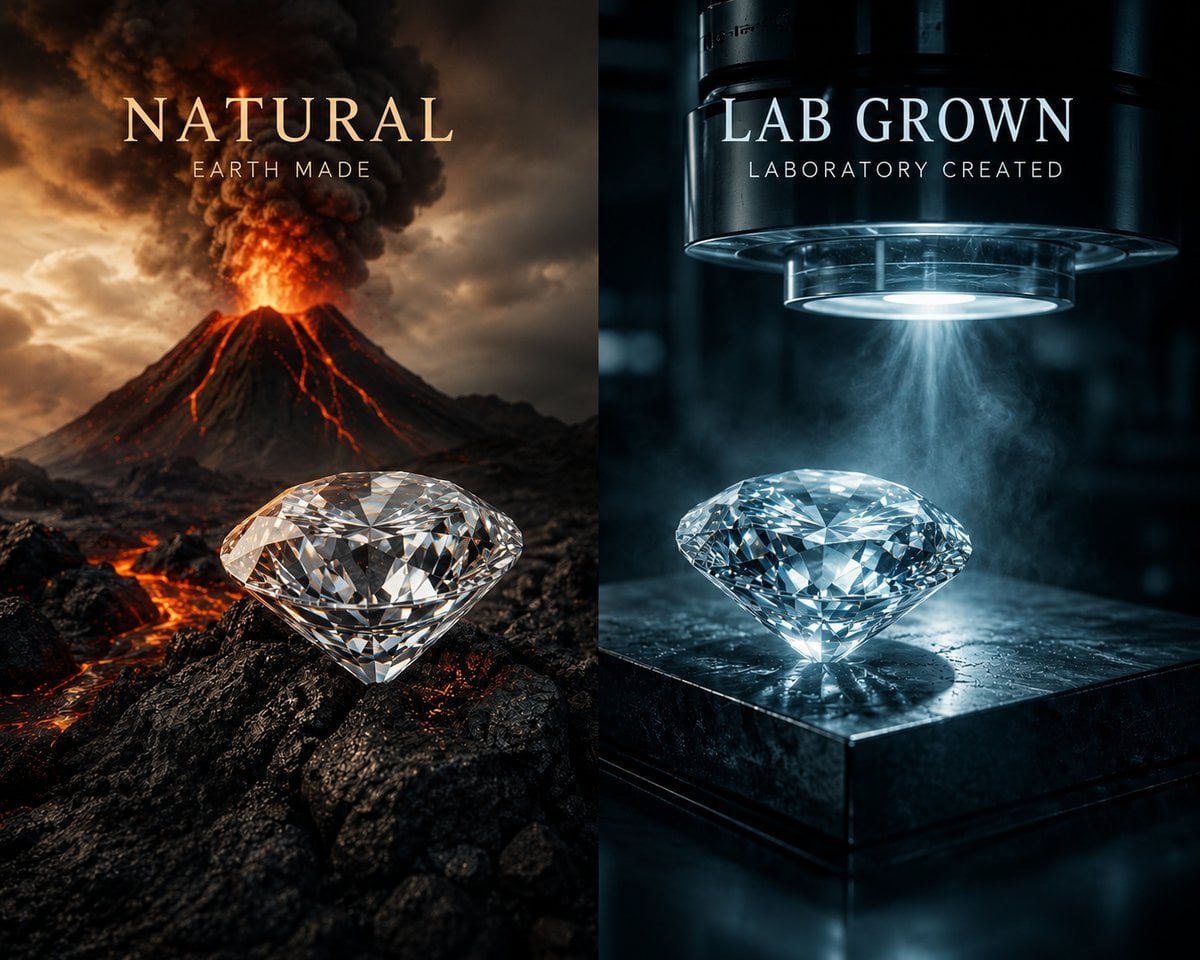
If you’ve started shopping for an engagement ring, you’ve run into the question within about five minutes: lab-grown or natural? There’s a lot of conflicting information online, and many articles naturally favor whichever type of diamond a retailer specializes in. This guide is simply here to explain the difference between lab-grown and natural diamonds so you can decide what’s right for you. Both are genuine diamonds, both are beautiful, and the right answer depends entirely on what matters to you — so let’s lay it out plainly.
Leaning natural? Here’s the full case for why natural is worth it →.
First: are lab-grown diamonds real diamonds?
Yes — and this is the part most people get wrong. A lab-grown diamond is not a “fake” or a simulant like cubic zirconia or moissanite. It is pure crystallized carbon with the exact same chemical composition, crystal structure, hardness, and optical properties as a diamond pulled out of the earth. Both score a perfect 10 on the Mohs hardness scale. Both sparkle the same way. In fact, the U.S. Federal Trade Commission updated its jewelry guidelines in 2018 to recognize lab-grown stones as diamonds, dropping the word “natural” from its definition of a diamond.
The primary difference is how they were created. A natural diamond formed over one to three billion years deep underground. A lab-grown diamond was made in a matter of weeks in a controlled facility. Once they’re both cut and polished, you cannot tell them apart with the naked eye — it takes specialized equipment in a gem lab to distinguish them, and even a standard “diamond tester” will read a lab-grown stone as a genuine diamond, because it is one. Origin does carry real consequences for price, rarity, and resale — and those are what the rest of this diamond buying guide covers.
Think of it like ice. The ice on a frozen winter pond and the ice cubes in your freezer are both, unmistakably, ice — the same frozen water, the same chill, the same melt in your drink. One just formed slowly out in nature; the other was made in minutes in a machine on your counter. Lab-grown and natural diamonds are the same story: identical material, different birthplace. Freezer ice isn’t “fake” ice — and a lab-grown diamond isn’t a fake diamond. It’s the real thing, simply made somewhere else.
How each one is made
Natural diamonds crystallized from carbon under enormous heat and pressure roughly 100 miles below the earth’s surface, then were carried up over millions of years by volcanic activity. Every one is geologically finite — there is a fixed amount in the ground.
Lab-grown diamonds are created with one of two technologies: HPHT (high pressure, high temperature), which mimics the earth’s conditions, or CVD (chemical vapor deposition), which builds the crystal layer by layer from carbon-rich gas. The result is the same material — just grown on a timescale of weeks and producible on demand.
The side-by-side, at a glance
| Lab-Grown Diamond | Natural Diamond | |
|---|---|---|
| What it’s made of | Pure crystallized carbon | Pure crystallized carbon (identical) |
| Hardness | 10 / 10 Mohs | 10 / 10 Mohs (identical) |
| Appearance | Indistinguishable to the eye | Indistinguishable to the eye |
| How it forms | Weeks, in a lab (HPHT or CVD) | 1–3 billion years, underground |
| Price (1 ct, similar quality)* | ~$500 – $1,500 | ~$4,500 – $7,000+ |
| Resale / value retention | Low (roughly 0–40% of retail) | Modest (roughly 20–60% of retail) |
| Rarity | Made to order, at scale | Finite and geologically rare |
| Certification available | Yes (IGI, GIA) | Yes (GIA, IGI) |
| Best for | Maximum size & sparkle per dollar | Heirloom appeal, rarity, better value retention |
*Illustrative 2026 figures for a comparable near-colorless, eye-clean 1-carat round. Actual prices vary by the 4Cs, certification, and retailer.

Price is where the real gap lives
This is the headline difference, and it’s bigger than it used to be. A few years ago lab-grown diamonds cost maybe 30–40% less than a comparable natural stone. As of 2026, after production scaled up dramatically, lab-grown diamonds typically cost a fraction of a comparable natural diamond — often 70–90% less at the same size and quality. For example, a 1-carat near-colorless natural diamond commonly runs several thousand dollars, while a lab-grown stone of similar specs can sell for a few hundred to around fifteen hundred.
Two things worth knowing. First, the gap has now stabilized — lab-grown prices hit a practical floor in late 2025, so the “wait and it’ll get even cheaper” expectation is largely over. Second, what this really buys you is choice: for the same budget, you can put a noticeably larger or higher-quality stone on the ring if you go lab-grown — or simply spend a lot less for the size you had in mind.
Worth knowing before you spend either way: the four grades on a diamond report do not carry equal weight. Cut changes how a stone actually looks far more than clarity does, and clarity is where most buyers overpay. Our diamond education guide ranks the 4Cs by how much each one really affects the diamond in front of you — that applies identically to lab-grown and natural stones.
Why are lab-grown diamonds cheaper?
Lab-grown diamonds cost less because they can be produced repeatedly in controlled environments. As growing technology improved through the 2020s, more producers came online, growth cycles got faster, and yields got better — so supply increased substantially while the cost to make each stone declined. A mined diamond carries an entirely different cost structure: exploration, extraction, sorting, cutting, and a supply that is geologically fixed. Finite supply plus high extraction cost is what holds natural diamond prices where they are.
The part worth saying plainly is that a lower price is not a signal of lower quality. A well-cut, certified lab-grown diamond and a well-cut, certified natural diamond with the same grades will look the same, wear the same, and last just as long. So when people ask whether lab-grown diamonds are worth it, the practical answer is that you are paying far less for identical material — and giving up rarity and resale value in exchange.
Which holds its value better?
Natural diamonds hold their value better than lab-grown diamonds, and the reason is supply. Because a lab-grown stone can be reproduced on demand, a secondhand buyer has little reason to pay a premium for yours, and resale offers typically come in far below what you paid. Natural diamonds have a fixed supply and an established secondary market, so they retain a more meaningful share of retail. If value retention is a factor in your decision, that gap is real — but it deserves the context below before you weigh it too heavily.
Neither type is a good financial investment. Retail markups mean most diamonds — natural included — resell for significantly below the original purchase price. The difference between a lab-grown diamond and a mined diamond here is one of degree, not category. Buy the stone because you love it and plan to keep it, not as an asset.
How to tell the difference between a lab-grown and a natural diamond
You can’t — not by eye, and not with a handheld tester. Separating a lab-grown diamond from a mined diamond takes spectroscopic instruments that read microscopic growth patterns, and that work happens inside a gemological laboratory. In practice, the answer comes from paperwork rather than observation: certified diamonds ship with a grading report that states the stone’s origin outright.
The Gemological Institute of America (GIA) — the nonprofit that created the 4Cs grading system the entire industry now uses — issues reports for both natural and laboratory-grown diamonds, and every GIA report identifies which one you are holding. The International Gemological Institute (IGI) grades a large share of lab-grown inventory and does the same. Many lab-grown stones are also laser-inscribed on the girdle with their report number and the words “lab grown,” readable under magnification. The rule for any diamond purchase is the same either way: buy certified, look up the report number on the lab’s own website, and read it before you pay.
What about sustainability?
You’ll see lab-grown marketed as the “eco-friendly” choice, and it’s more complicated than that. Neither option is automatically more sustainable. The environmental impact depends on how a particular lab-grown diamond was produced and how a particular natural diamond was mined. Lab-grown diamonds avoid the land disturbance and water use of mining — a real benefit. But growing them is energy-intensive, and the actual carbon footprint swings heavily on whether that energy comes from renewables or fossil fuels. Meanwhile, responsible modern mining is regulated and, in several countries, is a major source of jobs and public revenue. The bottom line: if sustainability is your priority, look for specifics (renewable-energy growers, or mines with credible certification) rather than trusting the label on either side.
So which should you choose?
There’s no universally “better” diamond — there’s the one that fits your priorities:
Choose lab-grown if…
You want the most size and sparkle for your money, you’re comfortable with the low resale value (because you’re keeping it), or you’d rather put the savings toward the wedding, the honeymoon, or the down payment on a house. For buyers looking to maximize size and quality within a budget, lab-grown diamonds are often the practical choice.
Choose natural if…
The idea of a billion-year-old, one-of-a-kind stone matters to you, you want the best value retention diamonds can offer, or you’re buying something you intend to pass down and want the “mined” provenance for sentimental or traditional reasons.
Either way, you’re getting a real diamond. The best diamond isn’t the one someone else tells you to buy — it’s the one that fits your budget, your priorities, and the story you want your jewelry to tell.
Still deciding between a lab-grown and a natural diamond?
At Monetary Jewelers we carry both. The goal isn’t to steer you toward one option — it’s to help you find the diamond that fits your budget, your priorities, and your style. Whether you’re shopping for an engagement ring, a pendant, or a pair of earrings, you can compare both side by side.
Shop engagement rings Read the 4Cs guideFound the diamond you want?See your monthly payment in seconds.
Lab-grown or natural, the financing works the same. Check the down payment and monthly cost on any ring or gift with the MJC Card — no guessing, no pressure — then apply when you’re ready.
Frequently asked questions
Are lab-grown diamonds real diamonds?
Yes. A lab-grown diamond is pure crystallized carbon with the same chemical, physical, and optical properties as a mined diamond. The U.S. FTC recognizes them as diamonds. The only difference is that one was grown in a lab and the other formed underground.
Will a lab-grown diamond pass a diamond tester?
Yes — a standard diamond tester reads a lab-grown stone as a genuine diamond, because it is one. Telling a lab-grown and natural diamond apart requires specialized equipment in a gemological lab.
Why are lab-grown diamonds cheaper?
They can be produced repeatedly in controlled environments. As growing technology improved, supply increased substantially while production costs declined. Natural diamonds require exploration, mining, sorting, and cutting, and their supply is geologically fixed — which is what keeps prices higher.
How much cheaper are lab-grown diamonds?
As of 2026, a comparable lab-grown diamond typically costs 70–90% less than a natural one at the same size and quality. A 1-carat stone that’s several thousand dollars in natural form may be a few hundred to around $1,500 lab-grown. The gap has stabilized rather than continuing to shrink.
Do lab-grown diamonds hold their value?
Not especially. Because they can be reproduced on demand, lab-grown diamonds usually resell for significantly below the original purchase price. Natural diamonds hold value better, but neither type is a sound financial investment once retail markup is accounted for. Buy the one you’ll love and keep.
Can anyone tell if my diamond is lab-grown?
Not by looking. To the eye they’re identical. Only a gemological lab with specialized instruments can distinguish them, and a certificate will state which type it is.
Are lab-grown diamonds worth it?
For most buyers, yes — if the goal is the largest, best-looking stone your budget allows. You get identical material at a fraction of the price. They are a weaker choice if resale value, rarity, or mined provenance is what you’re actually buying.
Does GIA certify lab-grown diamonds?
Yes. GIA issues grading reports for laboratory-grown diamonds as well as natural ones, and the report states the stone’s origin. IGI also grades a large share of lab-grown inventory. Whichever type you buy, buy certified diamonds and verify the report number on the lab’s website.
Which is better for an engagement ring?
Both are excellent and equally durable for everyday wear, and engagement ring diamonds of either type can be set in any style. Lab-grown gets you more size and sparkle per dollar; natural offers rarity and better value retention. It comes down to your budget and what the stone’s origin means to you.
Continue learning
- Diamond Education: the 4Cs, ranked
- Engagement Rings
- Solitaire Settings
- Diamond Pendants
- Diamond Stud Earrings
- Engagement Ring Monthly Payments
Prices and figures cited are illustrative market ranges for 2026 and vary by the diamond’s cut, color, clarity, carat weight, certification, and retailer. Financing is offered through the MJC Card and is subject to the current cardholder agreement and application requirements. This article is educational and is not financial or investment advice.