



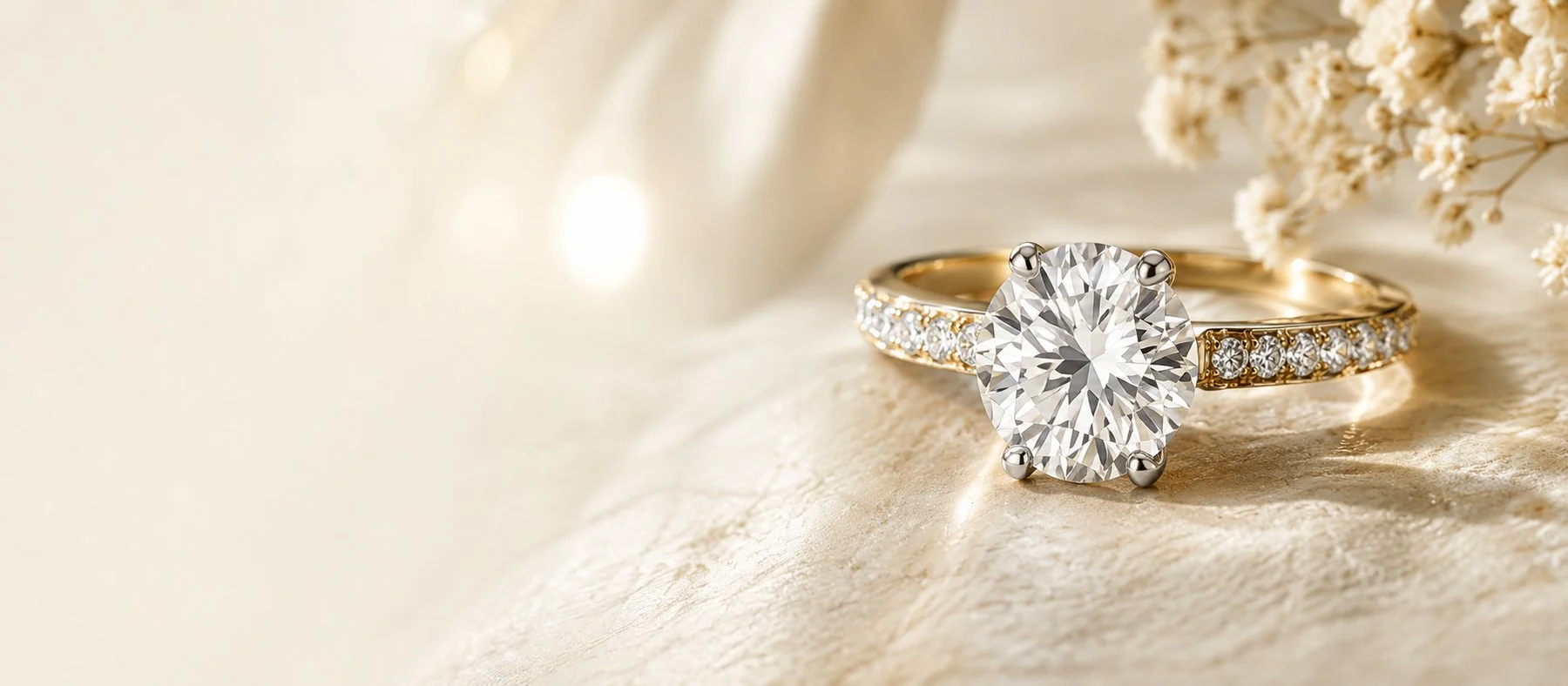
Everyone’s selling lab-grown.We still believe in natural.
As the market floods with mass-produced stones, a natural diamond has quietly become the rare, lasting, one-of-a-kind choice again. Here’s the honest case for the real thing.
For the last few years, the diamond world has had one obsession: lab-grown. And it’s easy to see why — they’re genuine diamonds, they’re beautiful, and they’re cheap. But here’s what all that noise has quietly done: it’s made a natural diamond the rare thing again. When every jeweler is racing to sell the same factory-made stone, choosing a diamond the earth took a billion years to make isn’t old-fashioned — it’s the standout move. This is the honest case for natural.
New to the natural-vs-lab-grown difference? Start with our full comparison →.
What the lab-grown flood did to the market
Lab-grown diamonds went from novelty to commodity in about five years. As production scaled up, prices fell dramatically — wholesale and retail lab-grown prices have declined by more than 90% from some early-market levels, making larger lab-grown diamonds significantly more affordable than they were a decade ago. Resale, though, is a different story, and analysts increasingly describe lab-grown the way you’d describe a laptop or a TV — a tech product that depreciates the moment it’s yours.
None of that makes lab-grown “bad” — it’s a genuinely great way to get maximum sparkle on a budget. But it does mean the market is now swimming in increasingly abundant, reproducible, and ever-cheaper stones. And when something becomes infinite and interchangeable, the thing that’s finite and one-of-a-kind starts to look a lot more special.
Rarity you can’t manufacture
A natural diamond can’t be reordered. Each one formed one to three billion years ago, under crushing heat and pressure about a hundred miles beneath the surface, and was carried up by ancient volcanic activity. There is a finite amount of it in the earth — and the supply is tightening, not growing. New diamond discoveries have slowed to a trickle, and many of the world’s major mines are approaching the end of their productive lives.
That’s the one thing a factory will never replicate. A lab can grow another million carats next quarter; the earth cannot make another billion-year-old stone on demand. Scarcity isn’t a marketing line here — it’s geology.
The value gap nobody advertises
Here’s the part most lab-grown marketing skips. Because natural diamonds are finite and lab-grown are not, the two hold value in completely different ways. Natural diamonds have a stronger, more established secondary market and tend to retain a meaningfully greater share of their purchase price. A lab-grown, by contrast, often recovers just 10–30% of what you paid — and sometimes close to zero.
Figures are illustrative 2026 market ranges and vary by the diamond’s 4Cs, certification, and where you buy and sell.
Let’s be honest: no diamond — natural or lab — is a smart “investment.” Retail markups mean you rarely get your full money back on any of them. But if you care at all about the piece holding meaningful worth over the years — for insurance, for a future upgrade, for passing it down — natural is in a different league.
An heirloom, not a trend
There’s a reason people describe a natural diamond as an heirloom and a lab-grown as a purchase. When a stone is truly one of a kind — formed over a billion years, carrying its own tiny fingerprints of that journey inside — it stops being just a product and starts being a story.
The luxury world has felt this shift. Buyers increasingly want objects that feel grounded, personal, and lasting rather than flashy and disposable — character over mass-produced perfection. A natural diamond is exactly that: something you choose once, wear for decades, and hand to someone who’ll do the same.
Why natural is the standout choice now
For most of the last decade, choosing natural was simply the default. Today it’s the statement. When every ad is pushing a bigger, cheaper lab-grown stone, a natural diamond signals something different — that you valued rarity and permanence over size-for-the-price. That’s not nostalgia; it’s the same instinct that pulls people toward anything real and finite in a world of infinite copies. It’s why there’s a growing push in the industry to reposition natural diamonds around exactly what a factory can’t copy — rarity, provenance, and permanence.
This isn’t anti-lab-grown. A lab-grown diamond is a real diamond, it’s gorgeous, and for plenty of shoppers it’s the smart, practical pick — especially if maximum size for your budget is the goal. We sell both, we always disclose exactly which one you’re getting in line with the FTC’s jewelry guides, and we’ll always tell you the truth about each. But if you want rarity, a stronger secondary market, and something built to be passed down, that’s exactly where a natural diamond stands apart.
Explore our natural diamond jewelry
Rare, one-of-a-kind, and made to last a lifetime — each piece a genuine part of the earth’s history. Shop natural diamonds across our collections:
Engagement & Wedding Rings →Frequently asked questions
Are natural diamonds worth the extra cost?
It depends on what you value. If you want the biggest, brightest stone for the lowest price, lab-grown wins outright. If you want genuine rarity, a stronger secondary market, and a one-of-a-kind piece to pass down, a natural diamond is worth the premium. Both are real diamonds — it’s a question of priorities, not quality.
Do natural diamonds hold their value?
Better than lab-grown, meaningfully so. Natural diamonds have a stronger, more established secondary market and tend to retain a greater share of their purchase price, while lab-grown often recover just 10–30% of retail and sometimes near zero. That said, no diamond is a true investment — retail markups mean you rarely recover the full purchase price of either.
What’s the real difference between natural and lab-grown?
Natural and lab-grown diamonds have essentially the same chemical, physical, and optical properties — it takes sophisticated lab equipment to tell them apart by their different growth histories. The fundamental difference is how and where they formed: a natural diamond formed over a billion years underground and is finite, while a lab-grown is made in weeks in a factory and can be produced without limit. That difference is what drives the gap in rarity, price, and resale value.
Are natural diamonds a good investment?
Not in the strict financial sense — you should buy any diamond because you love it, not to make money. But natural diamonds have a stronger, more established secondary market than lab-grown diamonds, making them the stronger choice if resale potential, rarity, or passing the piece down matters to you.
Why are natural diamonds more expensive than lab-grown?
Because they’re finite. A lab can produce more diamonds as demand grows, while natural diamonds cannot be manufactured and global mine supply is limited. That scarcity is a major reason natural diamonds command significantly higher prices than comparable lab-grown stones.
Prices, resale ranges, and market figures cited are illustrative 2026 estimates and vary by the diamond’s cut, color, clarity, carat weight, certification, and the retailer or resale channel. This article is educational and is not financial or investment advice.