

Blog
Best engagement rings for bad credit in 2026

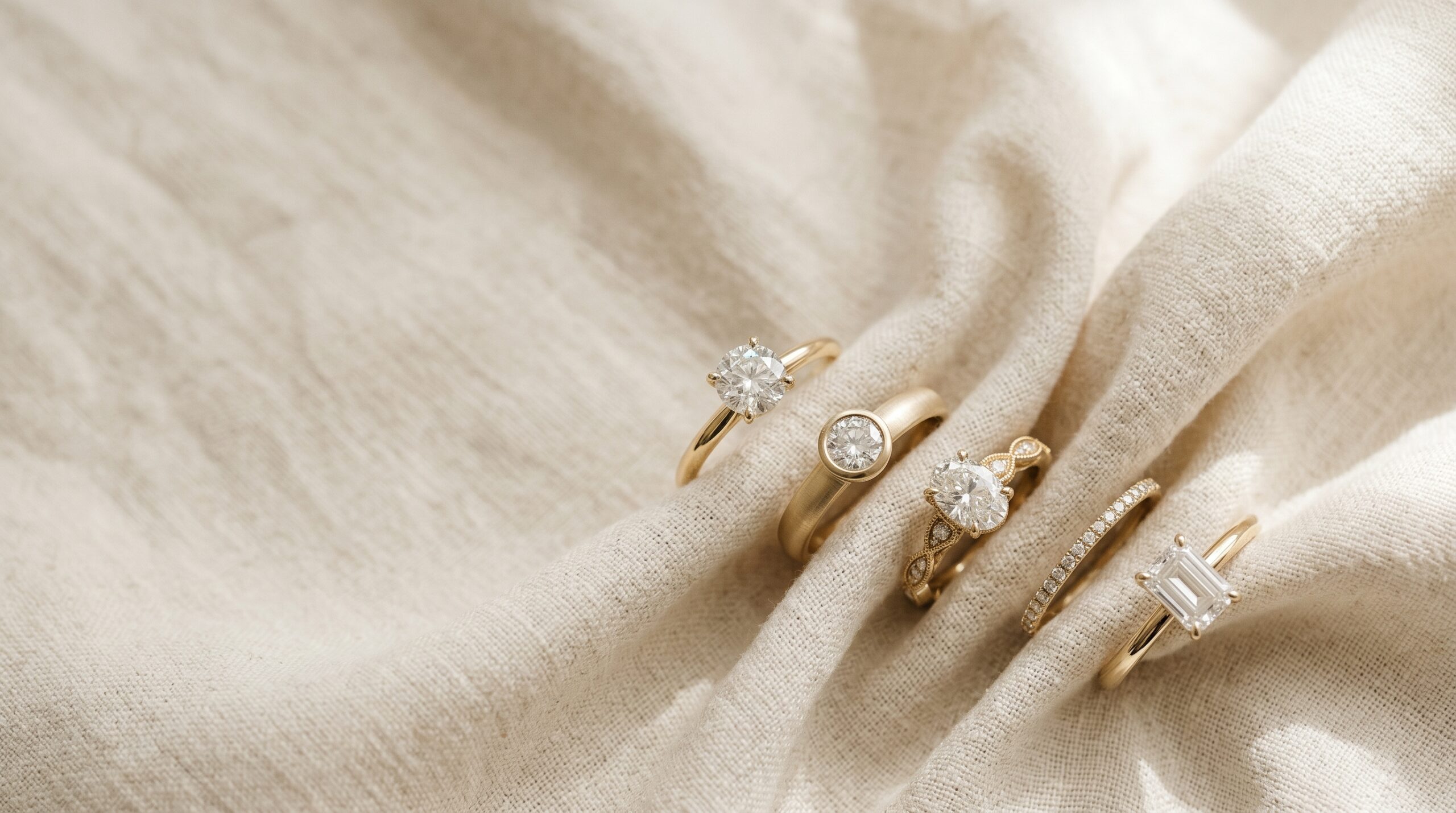
Buying an engagement ring is one of the most meaningful purchases most people ever make. It’s also one of the first places a low credit score, a thin credit file, or a rough patch from a couple of years ago can get in the way.
In 2026, “bad credit” no longer means settling for something you don’t love. Between approval-focused financing, payment plans that don’t require a hard credit pull, and credit-building jewelry financing like the MJC Card, there are several routes to a ring that looks and feels like the one you’d pick with no budget constraints.
This guide covers what counts as bad credit when you’re shopping for a ring, which financing options do and don’t help you over the long run, the ring styles that give you the most visual impact per financed dollar, and how to walk into a purchase with a plan instead of a hope.
Ready to compare real rings with financing available? Browse engagement rings or review how the MJC Card works before you apply.
What counts as “bad credit” when you’re shopping for a ring
Most lenders use the FICO scale:
- Excellent: 800 and up
- Very Good: 740–799
- Good: 670–739
- Fair: 580–669
- Poor: below 580
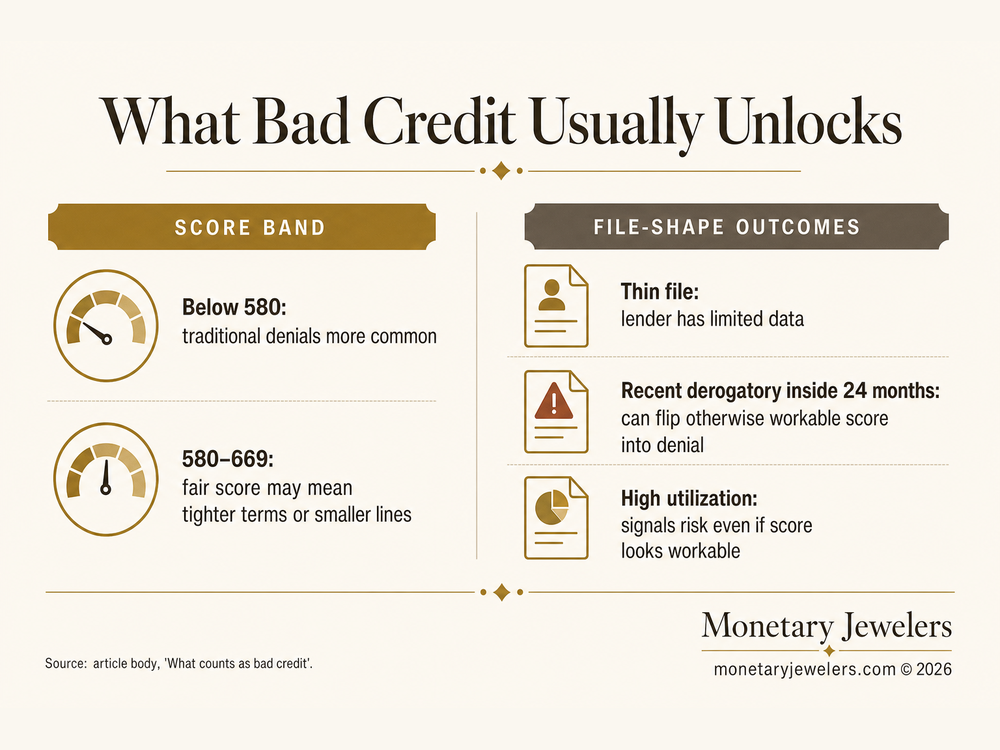
Traditional jewelry-store financing through banks and captive lenders usually wants a score in the Good band or higher. Scores in the Fair range often trigger either a denial or a much smaller credit line than the ring you want. Scores below 580, or a file with no established history at all, are typically the end of the road at that kind of counter.
But “bad credit” as a shopping barrier isn’t only about the number. It’s also about the shape of your file. A thin file (fewer than three open accounts, or less than a year of history) makes it hard for a lender to assess you at all. Recent derogatories like a late payment, a charge-off, or a collection item inside the last 24 months can flip an otherwise workable score into a denial. High utilization on the cards you already have signals risk even if your score looks fine on paper. A past bankruptcy or repossession still on your report can sit on top of any of those.
Each of those can push a traditional approval to “no” even if the raw score looks workable. That’s the gap approval-focused and no-credit-check financing programs exist to fill.
Can you finance an engagement ring with bad credit?
Yes, and it’s more common than most first-time buyers realize.
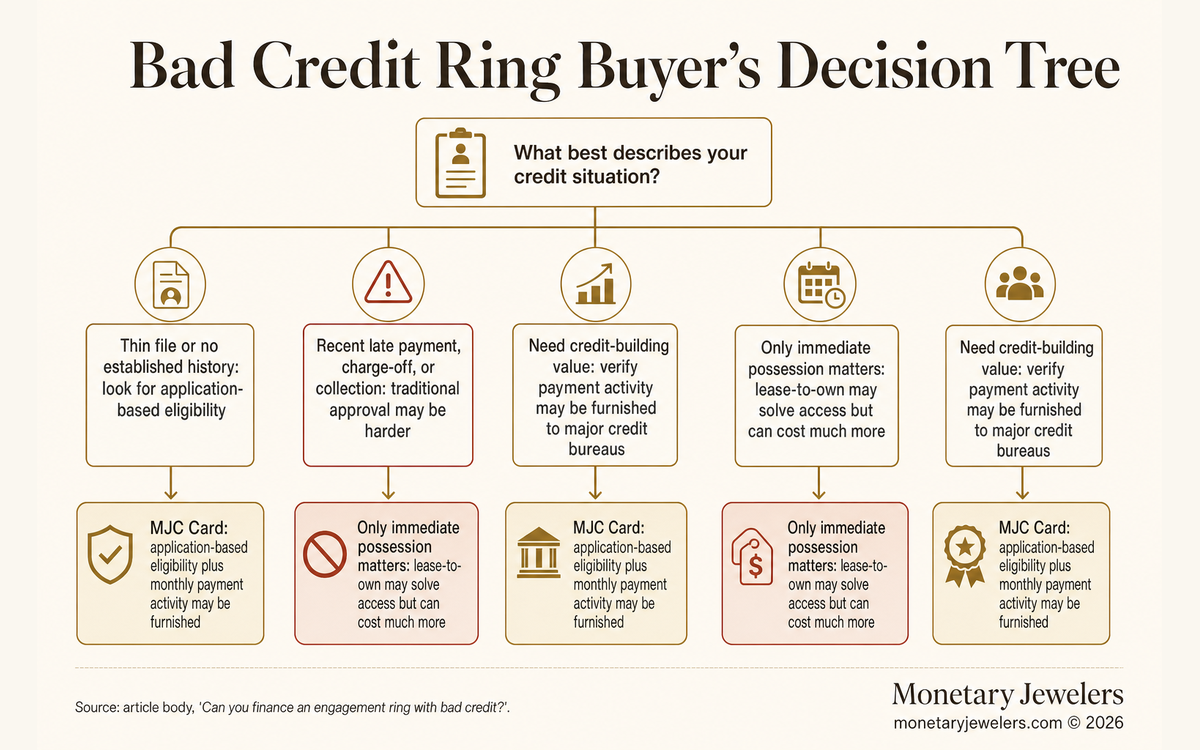
Approval-focused financing programs evaluate applicants differently than a bank’s underwriting model does. Instead of leaning entirely on a three-digit credit score, they can weigh income stability, bank-account history, and repayment behavior to make a decision.
The result is a much wider approval window. Buyers with limited credit history, a recent dip in score, no credit history at all, or a past bankruptcy or collections event can still qualify for structured monthly payments on a ring they’d pick for themselves, not a cubic-zirconia stand-in or a ring well below the quality they had in mind.
At Monetary Jewelers, customers nationwide can apply for the MJC Card in about five minutes, with application-based eligibility, and see their financing options before choosing a ring. For the full terms, down payment, and approval details, see our engagement ring financing guide. If you are comparing store approval paths first, start with our guide to jewelry stores that don’t check credit before narrowing the ring style.
The four kinds of “bad credit” engagement ring financing
Not every “buy-now-pay-later” option is the same, and the differences matter when you’re trying to avoid compounding a credit problem.
| Financing type | Credit pull | Reports payments to credit bureaus? | Total cost vs. cash | Builds credit? |
|---|---|---|---|---|
| Traditional store credit cards (jewelry-store cards and captive lenders) | Hard pull | Yes, but the deferred-interest trap can wipe out the benefit if the payoff deadline slips | Often higher than cash if the promo deadline is missed | Yes for on-time payments; a retroactive interest charge can hurt utilization |
| Buy-now-pay-later, BNPL (Affirm, Klarna, Afterpay, Sezzle) | Soft pull | Most short-term plans do not | Roughly equal to cash if paid on time | Usually no for short-term plans |
| Lease-to-own (Progressive Leasing, Acima, Snap Finance) | Application-based eligibility | Typically no | Often substantially more than cash price (lease-to-own can run roughly 2x the cash price) | No |
| No-credit-check financing that reports payments (MJC Card) | Application-based eligibility | Yes, to major credit bureaus monthly | Predictable at a fixed 19.90% APR | Yes |
Traditional store credit cards and captive lenders
These usually require a hard credit pull, which itself shaves a few points off your score whether you’re approved or not. Denial rates are high for scores under 640. The promotional “0% annual percentage rate (APR) for 12 months” offers almost always snap back to 28–30% APR the moment the promo ends, retroactively, if there’s any balance left. The Consumer Financial Protection Bureau’s 2024 Issue Spotlight on retail credit cards found that about one in five deferred-interest promotional balances ends in a retroactive interest charge, and that about 90 percent of retail credit cards carry maximum purchase APRs above 30 percent.
Buy-now-pay-later providers (BNPL)
Affirm, Klarna, Afterpay, Sezzle. These typically run a soft pull, which doesn’t affect your credit, and approval rates are friendlier. The catch is that most of these plans do not report on-time payments to the major credit bureaus (the Consumer Financial Protection Bureau says most Pay-in-4 BNPL products do not report to the major credit reporting companies). Making 12 flawless payments does nothing to help you build a stronger credit profile for the next big purchase, whether that’s a mortgage, a car, or a second ring a few years out. Affirm is a recent exception here: since 2025 it reports its pay-over-time loans, including Pay in 4, to Experian and TransUnion, though that data is not yet used in traditional credit scores.
Lease-to-own programs
Progressive Leasing, Acima, Snap Finance. These require no credit check and have high approval rates, but they’re structurally different from financing. You’re leasing the ring back from the provider, and lease-to-own plans typically cost substantially more than the cash price of the item by the time the lease completes. In the Federal Trade Commission’s 2020 Progressive Leasing settlement writeup, the FTC said the complaint alleged consumers would typically pay twice the retail price if they made the initial payment and all scheduled recurring payments. Costs vary by provider. Early-buyout options exist, but the math rarely works out in the buyer’s favor. Lease payments also typically aren’t reported as credit-building activity.
No-credit-check financing that reports payments to the credit bureaus
This is the narrowest category, and it’s the one to look for. The MJC Card, offered through Monetary Jewelers, sits in this bucket: application-based eligibility, payment activity is reported monthly to the credit bureaus, and structured monthly payments at a fixed 19.90% APR. Not a promotional rate that quietly resets.
Why “no credit check plus bureau reporting” is the combination that matters
Most “bad credit” financing solves the get-the-ring problem and quietly makes the fix-your-credit problem worse, or leaves it untouched.
Lease-to-own gets you the ring but costs you nearly double. BNPL gets you the ring at fair cost but builds no history. Store cards require a hard pull and often deny the people who need them most.
Financing that combines soft-approval with bureau reporting is rare. It lets the ring purchase become part of your credit-building plan. Payment activity on the MJC Card is reported monthly to the credit bureaus, and over 12 to 24 months of steady payments, that activity becomes part of your credit history. That’s the kind of record future lenders look for when you’re applying for a mortgage, a car loan, or your next financed purchase. Lenders that report to the credit bureaus are subject to the Fair Credit Reporting Act (FCRA, 15 U.S.C. § 1681s-2), which requires furnishers to report accurately and to investigate disputes.
You can learn more about how this works on the Build Your Credit page, which walks through the MJC Card’s application, terms, and credit-reporting mechanics in detail. For bureau coverage specifically, see which credit bureaus jewelry financing can report to.
Best engagement ring styles to finance in 2026
When you’re financing, the question changes. The right frame is which ring gives you the most visual and emotional impact for the budget you can finance comfortably. A few styles answer that better than others.
Solitaires
A single center stone on a clean band, typically four or six prongs, often in platinum or 14k gold. Solitaires remain the most popular engagement-ring style in 2026 because every dollar of your budget goes toward the center stone, which is the part that catches the eye. For a buyer financing around a strict monthly payment, a solitaire delivers the most carat-per-dollar while still reading as a classic ring. Browse our solitaire engagement rings, including a 14K white gold 4.00ct lab-grown solitaire with VS clarity and F colour.
Halos
A halo setting surrounds the center diamond with a ring of smaller accent stones, making the center stone look one-third to one-half carat larger than it is. A halo with a 0.75ct center stone reads visually like a 1.0ct-plus solitaire at a meaningfully lower total cost. Halos photograph well and work across traditional and modern tastes. Compare our halo engagement rings, from this cushion cut diamond halo to a 6.00ct oval halo.
Three-stone rings
Three-stone settings, sometimes called “trilogy” rings, symbolize past, present, and future, a narrative that matters to a lot of couples. Visually, they spread brilliance across a wider surface, which creates presence on the hand without requiring a single very large center stone. Financing a three-stone ring is often a smart middle path when you want a statement piece without leaning entirely on one heavy carat.
Lab-grown diamond rings
Lab-grown diamonds in 2026 continue to outperform natural diamonds on price per carat by roughly 70 to 80 percent at equivalent color and clarity grades. A lab-grown diamond is physically and chemically a diamond. Same hardness. Same brilliance. Same longevity. For a financed purchase, lab-grown is the biggest lever a buyer has to trade “a smaller ring I can barely afford” for “the size I want, on a payment plan I can carry.” See all lab grown engagement rings, up to a 6.50ct certified lab-grown ring.
Metals: white gold, yellow gold, or rose gold
White gold remains the default for engagement rings in the United States. Yellow gold is firmly back after a decade out of fashion, and rose gold keeps a steady share of buyers who want something slightly distinct. All three hold up similarly in 14k, which is the most financing-friendly option. Platinum runs roughly 40 to 50 percent more than 14k white gold at the same design, a meaningful difference on a monthly payment.
Browse the full diamond engagement ring collection to compare styles and financing options available nationwide.
How the MJC Card works for an engagement ring purchase
The MJC Card is Monetary Jewelers’ proprietary financing product, built for buyers who want a ring they’ll love and a payment plan they can carry, with eligibility governed by the current MJC Card agreement and application process.
The application is online and takes about five minutes. Review the current MJC Card agreement before applying so you understand eligibility review, consumer-report authorization, payment terms, and fees before you commit to a purchase.
Once approved, you choose your ring and pay 34% down at checkout, then finance the remaining balance over monthly payments. The minimum monthly payment is 7% of your original amount financed, or $50, whichever is greater. The APR is 19.90%, applied to the revolving balance. There’s no set payoff period. Paying more than the minimum any month reduces the total interest you pay over the life of the account.
Payment activity on your MJC Card is reported monthly to the credit bureaus. On-time payments can support your credit history over time. Late payments are reported as well, so the responsibility runs both ways, which is what gives the reporting weight on your credit file.
Worked example: financing a $1,500 engagement ring
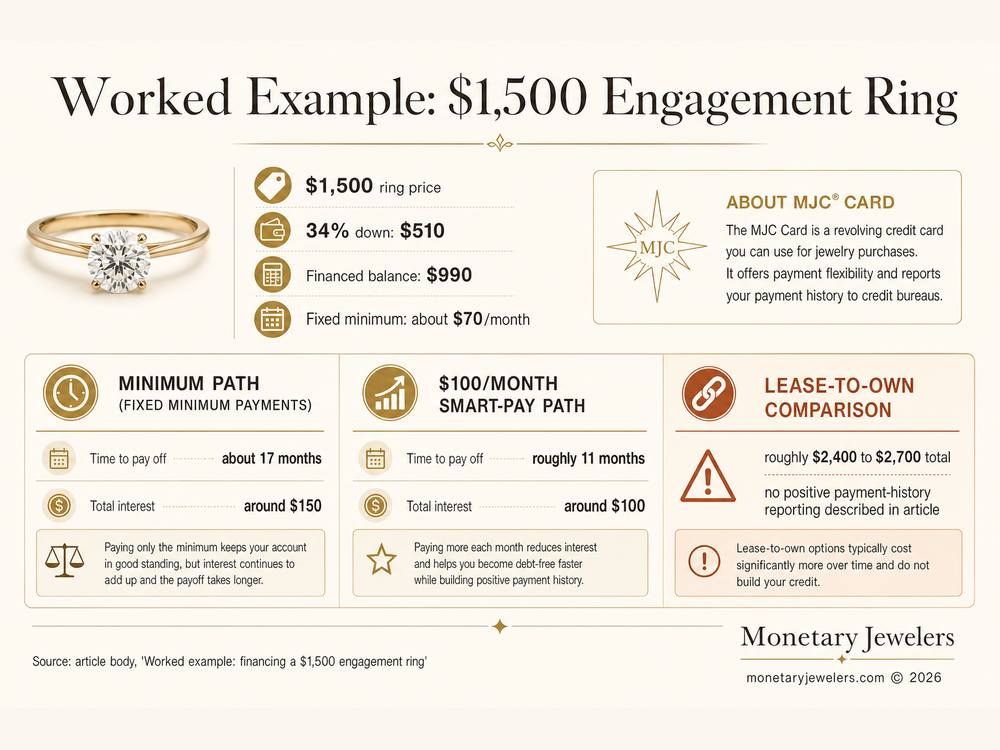
The math is easier to feel with specific numbers. Suppose you’ve picked a solitaire lab-grown engagement ring priced at $1,500. Your down payment is 34%, or $510. You finance the remaining $990. Your fixed minimum monthly payment is about $70 (7% of the original amount financed, above the $50 floor). The APR is 19.90% on the revolving balance.
If you paid only that fixed minimum each month and the balance stayed on a 19.90% revolving schedule, you’d finish the ring in about 17 months with total interest around $150. If you paid $100 a month instead, you’d finish in roughly 11 months with total interest around $100. The account’s monthly payment activity reports to the credit bureaus during that window.
Compare that to a lease-to-own plan on the same ring. On a $1,500 ring, that pattern is consistent with lease-to-own pricing, which often runs about twice the sticker price, putting total cost at roughly $2,400 to $2,700 by the time the lease ends, with none of the payments reported as credit-building activity. The MJC Card path gets you the same ring at much lower total cost, with credit history on the other side.
Find the right ring without credit barriers
An engagement ring should be about the person you’re giving it to, not about whether your FICO score landed above a specific cutoff two weeks before you walked in the door. Approval-focused financing has closed most of the gap that used to exist. Credit-building financing like the MJC Card has closed the rest of it.
The path is straightforward. Pick the style you want. Use a no-credit-check application to see your financing options. Choose a monthly payment that fits comfortably inside your budget. Let the on-time payments do the credit-building work in the background.
Browse the full engagement ring collection, or head to Build Your Credit to apply and see your options in about five minutes.
Frequently asked questions
Can I buy an engagement ring with a credit score under 600?
Yes, a score under 600 does not automatically rule out MJC Card financing. Eligibility is governed by the current MJC Card agreement and application process, so review the agreement before applying.
How does MJC Card application review work?
The MJC Card uses application-based eligibility and agreement-controlled review. Read the current agreement before applying so you understand consumer-report authorization, payment terms, and fees.
What’s the down payment on a financed engagement ring through Monetary Jewelers?
The MJC Card requires 34% of the purchase price as a down payment at checkout. On a $1,500 ring, that’s $510 down, with the remaining $990 financed.
What’s the monthly payment on a financed engagement ring?
The minimum monthly payment is 7% of your original amount financed, or $50, whichever is greater. On a $1,500 purchase with 34% down, that’s roughly $70 per month.
Does financing an engagement ring help build my credit?
It can, if your financing reports to the credit bureaus. The MJC Card may furnish payment activity to major credit bureaus, so on-time payments can support your credit history over time. Many BNPL and lease-to-own options do not report, which means they won’t contribute to your credit history.
What’s the difference between “no credit check” and “no credit needed” financing?
“No credit check” language is not always used consistently. Some programs may avoid a traditional hard-pull approval model, while still using consumer reports, identity checks, bank data, or other eligibility review. The MJC Card agreement authorizes consumer reports, so review the current application terms before relying on any no-credit-check claim. For the full breakdown, see no credit check vs. no credit needed jewelry financing.
Which engagement ring styles are best for a financed purchase?
Solitaires, halos, three-stone rings, and lab-grown diamond rings tend to give buyers the most visual impact for a given monthly payment. Lab-grown diamonds in particular let you step up to a larger carat size at the same financed price as a smaller natural stone.
Can I pay off my MJC Card balance early?
Yes. The MJC Card is a revolving account with no set payoff period. You can pay more than the minimum any month, or pay off the full balance at any time, with no early-payoff penalty. Paying ahead reduces the total interest you pay.
Is financing available for all engagement rings at Monetary Jewelers?
Yes. MJC Card financing is available on the full engagement ring collection, including solitaires, halos, three-stone rings, lab-grown diamonds, and custom pieces.
How long does the MJC Card application take?
About five minutes online. Approval decisions are typically fast, and there’s application-based eligibility.
Compare the full shopping collections: shop bridal sets or shop wedding bands.