


Blog
Diamond Tennis Bracelets: Settings, Styles, Stones and What They Cost

One continuous line of diamonds — but the setting, the shape of the stones and whether they’re natural or lab grown change the price, the width and how it wears every day.
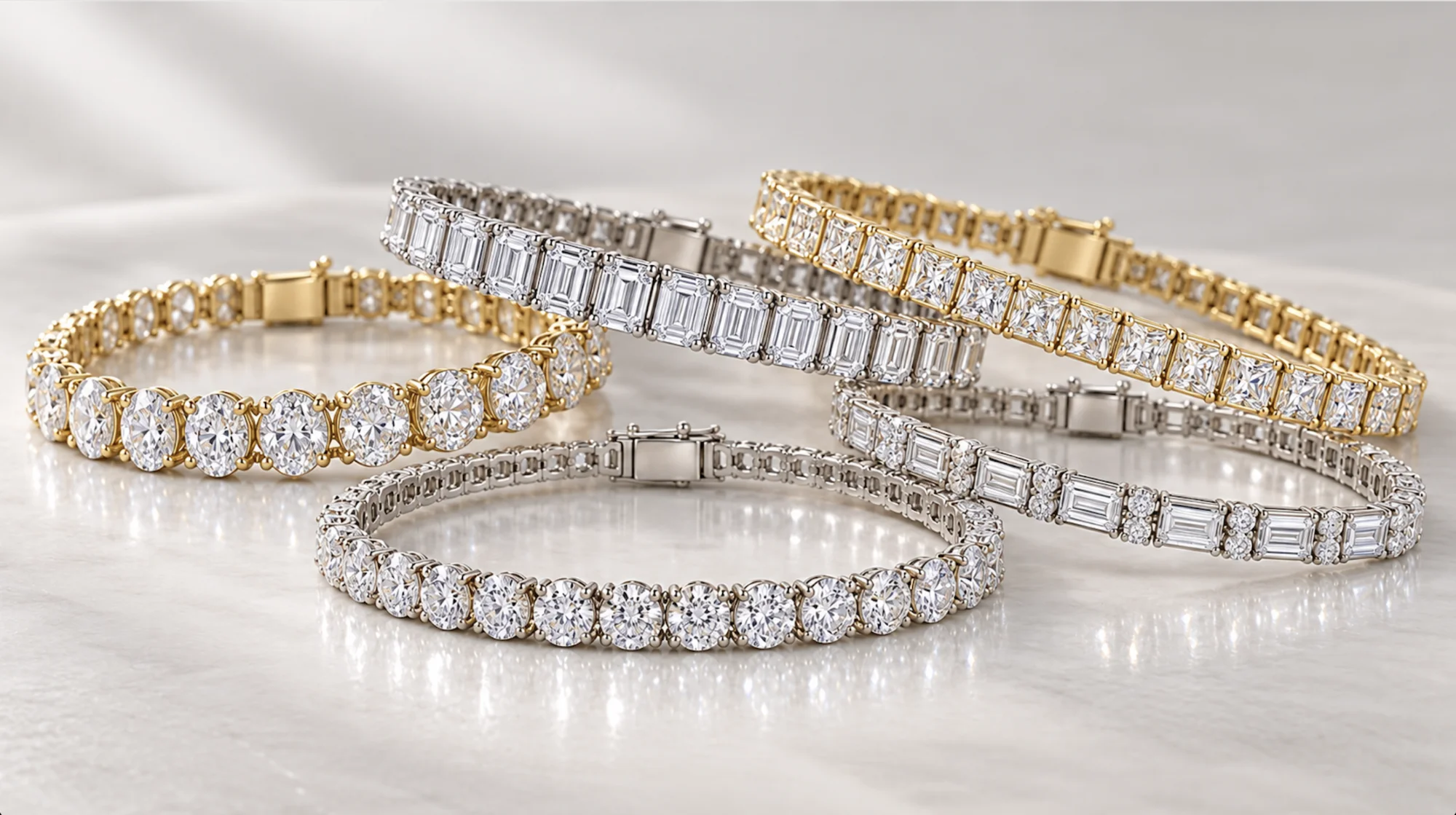
A tennis bracelet is a flexible bracelet set with a continuous line of diamonds or gemstones around the wrist. A good one moves easily without feeling loose, keeps the stones sitting upright, and looks like a nearly uninterrupted line of light when it’s on.
The name is tied to Chris Evert. She later recalled that her diamond line bracelet came off during an early-round match at the 1978 U.S. Open and that play was paused while she searched for it. The jewelry style was already around long before that match, and the phrase “tennis bracelet” spread gradually afterward, but the Evert story became permanently attached to the name.
There is much more variation within the category than the name suggests. Tennis bracelets can be made with natural or lab grown diamonds, round stones or fancy shapes, open prongs or heavier bezel settings, one row or several. Those choices change the look of the bracelet, but they also change its price, width, durability and how it feels to wear every day.
How much does a diamond tennis bracelet cost?
Diamond tennis bracelet prices range from under $2,000 to tens of thousands of dollars or more. The biggest variables are total carat weight, whether the diamonds are natural or lab grown, the size of the individual stones, diamond quality, metal and how complicated the bracelet is to build.
At Monetary Jewelers, our diamond tennis bracelets currently run from $3,360 to $12,390, with total diamond weights from 1 to 9 carats. Most are made in 14K white or yellow gold, with two 10K bracelets at the entry price. Most of the collection uses lab grown diamonds listed at F color or better with VS clarity, while a smaller group is made with natural diamonds in the H–I color range.
| Our current collection | At a glance |
|---|---|
| Price range | $3,360 – $12,390 |
| Total diamond weight | 1 ct to 9 ct |
| Metals | 14K white and yellow gold; two 10K pieces at the entry price |
| Diamond origin | Mostly lab grown, with a smaller natural selection |
| Lab grown quality | F color or better, VS clarity |
| Natural quality | H–I color range |
| Designs | Classic round lines, flower-set and multi-shape |
| Clasp | Box clasp with figure-eight safety latch on every bracelet |
Carat weight is important, but don’t judge a bracelet from that number alone. Two bracelets can both weigh 5 carats and look completely different on the wrist. One might use many smaller diamonds packed closely together; another may use fewer, larger stones. Larger individual diamonds usually command a higher price per carat, particularly with natural diamonds, so total weight only tells part of the story.
The construction matters too. A simple straight line of round diamonds is relatively straightforward to build. Start adding multiple rows, halos, alternating shapes or flower clusters and there is more matching, setting and finishing involved.
Total carat weight sets the ballpark. Natural versus lab grown moves it the most after that. Then the size of the individual stones, because ten 0.50 ct diamonds cost less than five 1.00 ct diamonds at the same total weight. Metal and construction fill in the rest. If you’re comparing bracelets online, look at all of those together rather than assuming the bracelet with the largest carat number is automatically the better piece.
How tennis bracelet settings change the look
The setting is what physically holds every diamond in the bracelet. It also determines how much metal you see, how high the diamonds sit and how smooth the bracelet feels against clothing and skin.
| Setting | What you see | Best suited to |
|---|---|---|
| Four-prong | Maximum diamond, minimum metal | The classic, brightest look |
| Shared prong | Tighter line, less visible metal | Reading almost entirely as diamonds |
| Bezel | A metal rim around every stone | Hard daily wear and a modern look |
| Semi-bezel | Metal on two sides, open on two | A middle ground between the two |
| Channel | Stones between continuous rails | The smoothest surface; snag-free |
| Bar | A metal bar between each stone | A visible, architectural rhythm |
| Illusion | Shaped metal that extends the outline | More width without larger stones |
| Cluster / flower | Groups of stones reading as one | Maximum spread per carat |
Four-prong
Four-prong is the classic tennis bracelet construction. Each diamond sits in a small head with four prongs holding it securely while leaving most of the stone exposed.
That open construction is part of why a traditional round-diamond tennis bracelet looks so bright. You see diamond first and metal second. It also gives the bracelet the familiar individual-stone definition people expect from a classic line bracelet.
Prongs are the part that eventually needs attention. On a bracelet worn regularly, they should be inspected periodically for thinning, bending or loosening. A worn prong is much easier to repair before a diamond has a chance to move or fall out.
Shared prong
Shared-prong construction reduces the amount of metal between neighboring diamonds. Instead of every stone appearing inside a completely separate head, adjacent diamonds share some of the setting structure.
The result is a tighter-looking line with less visible metal. If someone wants the bracelet to read almost entirely as diamonds across the wrist, shared prongs are worth looking at.
The tradeoff is that the workmanship matters. When the stones sit this close together, uneven spacing or a poorly aligned diamond becomes easier to notice.
Bezel
A bezel wraps a rim of metal around the outside of each diamond. It gives the stone more edge protection and creates a smoother surface than an exposed prong setting.
The appearance is different too. You see more metal around every stone, which makes the bracelet feel cleaner and more modern rather than delicate and traditional.
For someone who wears a tennis bracelet frequently, works with their hands or does not want exposed prongs catching on clothing, a bezel can make a lot of sense.
Semi-bezel
Semi-bezel or half-bezel construction holds each diamond from two sides while leaving the other sides open.
It is a good middle ground for someone who likes the clean structure of a bezel but doesn’t want a complete metal border around every stone. More of the diamond stays visible and the bracelet still has a smooth, structured profile.
Channel setting
In a channel-set bracelet, the diamonds sit between continuous rails of metal rather than beneath individual prongs.
Run your finger across the top and it feels much smoother than a traditional prong-set line. Visually, the metal rails become part of the design instead of disappearing behind the stones.
Channel settings are especially effective with smaller stones or geometric designs. They are less about making every diamond look individually suspended and more about creating one clean strip of diamonds and metal.
Bar setting
Bar settings place a vertical section of metal between neighboring diamonds while leaving the other sides open.
The bars create a visible rhythm all the way around the bracelet. It’s more architectural than a classic prong line but still exposes plenty of each diamond.
Illusion setting
An illusion setting uses shaped or faceted metal around a smaller diamond to make the complete setting look larger from a distance.
The diamond itself hasn’t changed size. The metal is doing part of the visual work. That can be useful when someone wants a wider appearance without putting the entire budget into larger individual stones.
Cluster and flower settings
Cluster and flower settings take a completely different approach. Instead of one diamond creating each link, several smaller diamonds are arranged together so the group reads as one larger shape.
A flower-set tennis bracelet can look much wider than a conventional straight line at a similar total carat weight because the diamonds are spread across a larger area of the wrist. We carry flower-set designs in our current collection.
Tennis bracelet styles
Most people picture a single straight row of matching round diamonds, and that is still the foundation of the category. But changing the stone size, number of rows or sequence of shapes changes the bracelet quickly.
Classic straight line
The classic line uses diamonds of roughly equal size all the way around the wrist. Done well, there should be no obvious high stone, low stone or strange gap pulling your eye away from the line.
It is the easiest version to wear every day because there isn’t really a front or back apart from the clasp. The bracelet looks balanced regardless of how it rotates on the wrist.
Graduated
A graduated bracelet starts with smaller stones near the sides and clasp, then increases in size toward the center.
That puts the visual weight on top of the wrist, where the largest diamonds can be seen. It feels a little more formal and intentionally designed than an equal-size straight line.
Matching is especially important here. The jumps in size should look gradual; if one stone suddenly looks larger than the next, the effect falls apart.
Multi-row
Two or three rows turn a tennis bracelet into a much wider piece of jewelry.
One thing buyers sometimes miss is that total carat weight is now spread across several lines. A 6-carat three-row bracelet and a 6-carat single-row bracelet will not look remotely the same. The multi-row piece covers more width, while the single-row version concentrates the weight into larger individual stones.
Neither is better. They are simply different looks.
Multi-shape
A multi-shape bracelet breaks up the repetition by combining different diamond cuts. Rounds may alternate with baguettes, or a design may use combinations of oval, pear, marquise, emerald and princess cuts.
These are harder to make well than they look. Different diamond shapes have different proportions, heights and setting requirements, so the jeweler has to make the entire sequence sit evenly while keeping the spacing consistent.
We carry multi-shape designs in our current collection.
Round and baguette
Round-and-baguette is one of the cleanest ways to mix shapes. Round brilliant diamonds throw off smaller flashes from many directions; baguettes produce longer, straighter flashes.
Alternating the two gives the bracelet contrast without making it busy. It works particularly well when someone likes a traditional diamond bracelet but wants something less predictable than an all-round line.
Halo
In a halo tennis bracelet, each primary stone is surrounded by smaller diamonds. That creates a much wider outline and a lot more surface sparkle.
It also means more stones, more prongs and more setting work. A halo bracelet should be inspected carefully because the small accent stones matter just as much as the centers when it comes to workmanship.
Two-tone
Two-tone construction mixes white and yellow metal in the same bracelet. You might see white gold holding the diamonds with yellow gold used through the links or other visible parts of the design.
It is useful for someone who already mixes metals because the bracelet doesn’t force the rest of the jewelry on the wrist into one color.
Natural vs. lab grown diamond tennis bracelets
For high-carat tennis bracelets, the choice between natural and lab grown diamonds can change the price dramatically. We cover this comparison in more depth in our guide to lab grown vs. natural diamonds.
Natural diamonds
Natural diamonds formed in the earth and are mined from natural deposits. Their natural origin and rarity are part of what buyers are paying for, and comparable natural stones cost substantially more than lab grown diamonds in most current jewelry applications.
That price difference becomes very noticeable in a tennis bracelet because you’re not buying one diamond. A bracelet can contain dozens of matched stones, and the cost of matching that many natural diamonds adds up quickly.
Lab grown diamonds
Lab grown diamonds are diamonds produced in a controlled laboratory environment rather than formed underground. They have essentially the same chemical, physical and optical properties as natural diamonds, although specialized gemological equipment can identify their laboratory-grown origin.
Their lower price per carat is why lab grown diamonds have opened up much larger tennis bracelets to buyers who would not spend the equivalent amount on natural stones. Moving from 3 carats to 7 or 9 carats becomes much more attainable when the diamonds are lab grown.
If natural origin matters to you, buy natural. If your priority is getting more diamond size for the budget, lab grown deserves a serious look. There isn’t a wrong answer here — there’s just what you want the piece to be.
Colored gemstone tennis bracelets
The continuous-line format isn’t limited to diamonds. Sapphire, ruby and emerald can be used on their own or alternated with diamonds.
Sapphire and ruby are especially well suited to frequently worn jewelry because both belong to the corundum family and are very hard. Emerald has a completely different character and gives a beautiful color line, but it needs more care because emeralds are more likely to contain natural inclusions and can be more vulnerable to impact.
Mixing gemstones with diamonds also changes how a bracelet reads from across the room. A blue sapphire-and-diamond line, for example, has much more visible pattern than an uninterrupted row of white diamonds.
Diamond shapes used in tennis bracelets
Round brilliant is by far the shape most associated with tennis bracelets, but it is not the only shape that works.
Round brilliant
Round brilliant diamonds are easy to match into a repeating line because the shape is symmetrical from every direction. Their faceting also gives the high-sparkle appearance people expect from a traditional tennis bracelet.
Most of the bracelets in our collection use rounds.
Princess cut
Princess cuts replace the round outline with a square one while keeping brilliant-style faceting.
Put them side by side and the bracelet takes on a sharper, more geometric edge. They are a good choice for someone who wants plenty of sparkle but doesn’t want the usual round-diamond look.
Emerald and Asscher cuts
Emerald and Asscher diamonds are step cuts. Instead of the scattered sparkle of a round brilliant, their larger facets create broader flashes of light.
They also show the interior of the diamond more openly, so poor matching is harder to hide. On a full bracelet, differences in clarity, color or cut can become noticeable from stone to stone.
Baguette
Baguettes are narrow rectangular step cuts and are especially effective when alternated with rounds.
An entire baguette line can look extremely clean and architectural, while alternating them with brilliant cuts gives the bracelet more contrast.
Oval, pear and marquise
Oval, pear and marquise diamonds all have elongated outlines. That additional length gives them more visible spread along the wrist than a compact round outline.
They also make the piece feel much less conventional. The important part is orientation: every stone has to point and sit consistently or the irregularity becomes obvious immediately.
How to judge the quality of a tennis bracelet
This is where looking only at carat weight will get you in trouble.
A tennis bracelet is a matched piece of jewelry. You are not buying one beautiful center diamond surrounded by accents; you are looking at an entire line of stones at once. If one is darker, smaller, crooked or set too high, your eye will eventually find it.
Look at the diamonds as a group
Color and clarity matter less on their own here than they do in a solitaire, because no single stone is carrying the piece. What matters is that they match. A line of well matched I color diamonds looks better on the wrist than a line that mixes G and J, even though the second group grades higher on paper.
The same is true of clarity. Inclusions you would never notice in one stone become distracting when only three stones in the row have them and the rest are clean.
Check that the stones sit level
Lay the bracelet flat on a table or across your palm and look at it from the side. The tops of the diamonds should form one continuous line. A stone that sits high catches on clothing and takes the impact every time your wrist brushes a doorframe. A stone that sits low looks dull next to its neighbors because it is not picking up the same light.
Flex the bracelet
Hold each end and let it drape. It should curve smoothly and follow the shape of your wrist. If it bends in steps, or if a section stays stiff while the rest moves, the links are not articulating evenly. That usually shows up later as uneven wear at the joints.
Look at the back
Turn the bracelet over. The underside is where shortcuts hide. Prongs and links should be finished and smooth, not rough where they were cut or soldered. Open gallery backs let light in from underneath and make the diamonds brighter, and they also let you actually see whether the stones are seated properly.
Inspect the clasp and the safety
The clasp is the part most likely to fail, and it is the part people check last. A box clasp with a figure eight safety latch is the standard on quality tennis bracelets: the clasp holds and the latch is the backup if the clasp opens. Every tennis bracelet we carry is built this way.
Work the clasp a few times. It should close with a clear, positive snap, not a vague push. A clasp that feels loose in the store will not get tighter with wear.
Gold and platinum
The metal changes the color of the piece, what it costs and how it holds up over years of daily wear.
White gold
White gold is the most common choice for tennis bracelets because it is neutral and lets the diamonds read as white. It is gold alloyed with white metals and then plated with rhodium, which is what gives it that bright finish. Rhodium wears off over time, especially on a bracelet that spends all day rubbing against a desk or a sleeve, so plan on having it replated periodically. It is inexpensive and takes very little time.
Yellow gold
Yellow gold gives the piece more warmth and more contrast against the stones. It has come back strongly in the last several years, and it needs no plating, so the color you buy is the color you keep. Half of our tennis bracelet inventory is yellow gold and half is white.
Rose gold
Rose gold gets its color from copper in the alloy. It is softer looking than yellow and reads warmer against most skin tones. We do not currently stock rose gold tennis bracelets, but it is a straightforward custom order.
10K, 14K and 18K
Karat is simply how much of the metal is pure gold. 10K is about 42 percent gold, 14K about 58 percent and 18K 75 percent. The rest is alloy.
More alloy means a harder, more scratch resistant metal and a lower price, which is why 10K holds up well on a piece that gets knocked around. More gold means richer color and a higher price, which is why 18K looks the way it does. 14K sits in the middle and is the standard for fine jewelry in the United States for exactly that reason.
Most of our tennis bracelets are 14K. We also carry two 10K pieces, and 18K is available as a custom order.
Platinum
Platinum is naturally white, so it never needs rhodium plating and never shifts color. It is also denser than gold, which is why a platinum bracelet feels noticeably heavier on the wrist. When platinum is scratched the metal is pushed aside rather than worn away, so it develops a soft patina over the years instead of thinning. It is also a good option for people who react to the nickel in some white gold alloys.
It costs more than gold, both for the raw metal and for the labor, since platinum takes more work to fabricate. We do not stock platinum tennis bracelets, but we build them to order.
What length tennis bracelet should you buy?
Seven inches is the standard length and fits most women. Longer options are typically 7.5 and 8 inches, and men’s tennis bracelets generally run 8 to 8.5 inches.
To size yourself, wrap a strip of paper or a soft tape around your wrist just below the wrist bone, mark where it meets, and measure it. Add about half an inch to three quarters of an inch to that number. The quick check once it is on: you should be able to slide one finger between the bracelet and your wrist. If two fit easily it is too loose, and if none fit it is too tight.
Fit matters more on a tennis bracelet than on almost any other piece. Too loose and it slides down over your hand and takes hits it should not take. Too tight and it will not drape, so it sits stiff instead of following your wrist. Either way, a flexible line bracelet can rotate frequently as you move, so the clasp will not stay put on the underside of your wrist the way a rigid bangle does. That is normal.
If you fall between sizes, most tennis bracelets can have links added or removed. Ask before you buy, because a channel set or bar set bracelet is harder to resize than a shared prong line.
Don’t see the tennis bracelet you want?
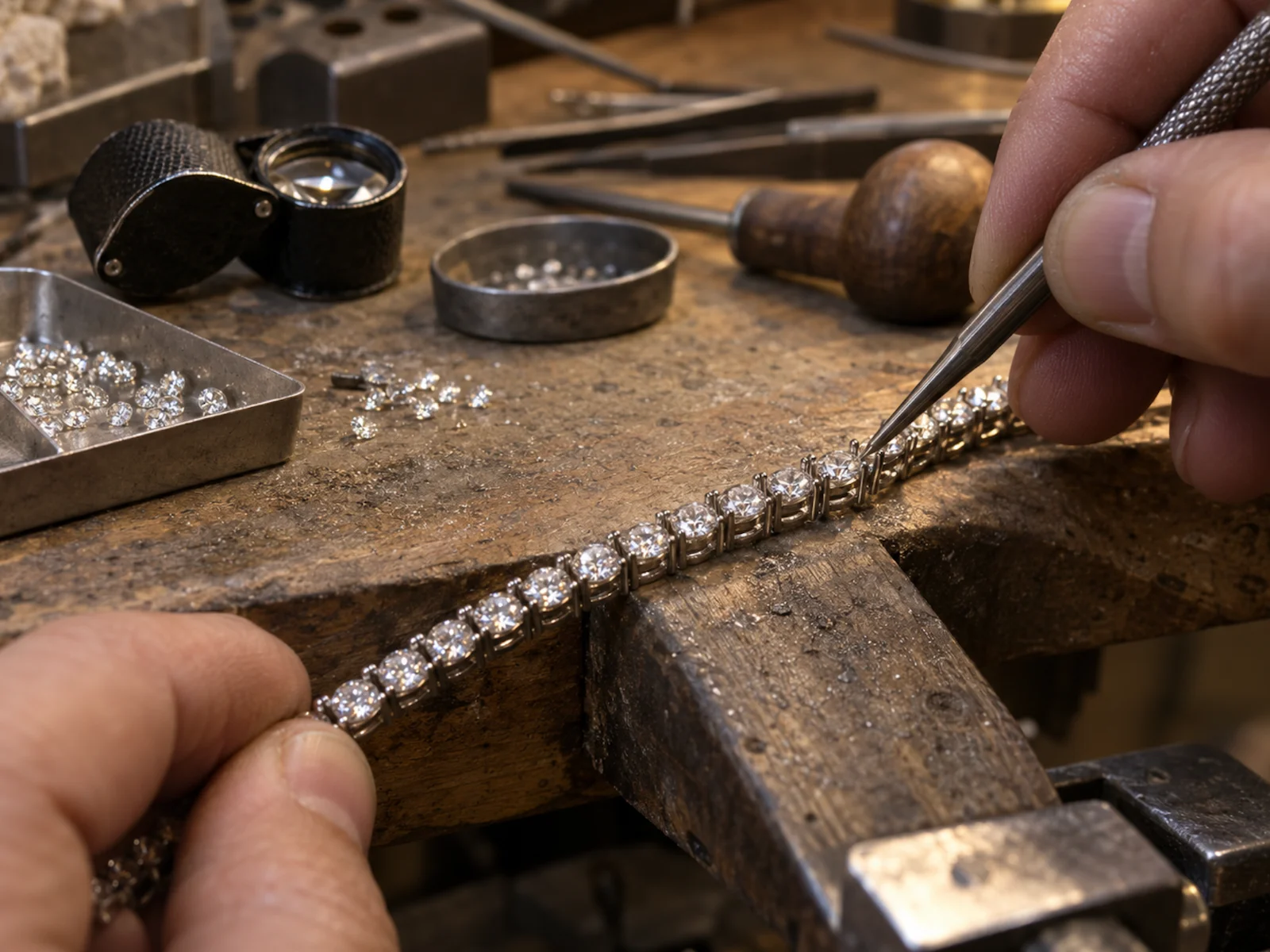
Everything above is worth knowing whether or not you buy from us, and plenty of it describes bracelets we do not have sitting in a case. We do custom work, so the styles and settings we do not stock are not off the table.
If you want a bezel set line in rose gold, a graduated bracelet that starts at a specific carat weight, an emerald cut row, a two tone piece, a sapphire and diamond alternating line, or a platinum bracelet built to a length we do not carry, we can make it.
Tell us what you have in mind
Send us the details — a photo or screenshot if you found something you like, your budget, and your wrist measurement — and we’ll come back to you with what it would take to build it. If you’d rather start with what’s in stock, the current collection is a good place to begin.
Email us about a custom piece Shop what’s in stockFinancing a diamond tennis bracelet
A tennis bracelet is one of the pieces people most often finance, because it is a real purchase and it is usually bought for an occasion with a date attached to it.
We offer financing through the MJC Card. We never pull your credit, and approval is based on your application and is not guaranteed.
34% down · 19.90% APR · $1,500 minimum purchase · minimum monthly payment of $50 or 7% of the amount financed, whichever is greater · no prepayment penalty · reported to the credit bureaus monthly · available in all 50 states. Every tennis bracelet we carry is above the $1,500 minimum.
You can read the full details on our jewelry financing page.
Diamond tennis bracelet FAQs
Why is it called a tennis bracelet?
The name comes from Chris Evert, who by most accounts lost her diamond line bracelet during a match at the 1978 US Open and asked for play to be paused while it was found. The story spread, and jewelers eventually started calling the style a tennis bracelet. The term shows up in print in the mid 1980s. Before that, and still today in the trade, the same piece is called a line bracelet or an eternity bracelet.
How much does a diamond tennis bracelet cost?
It depends almost entirely on total carat weight, then on diamond quality and metal. Small total weights in lab grown diamonds can be found for under $2,000. Our own tennis bracelets run from $3,360 to $12,390, covering 1 carat to 9 carats total weight. A large natural diamond bracelet in high color and clarity can run well past that.
How many carats should a tennis bracelet be?
There is no correct answer, but there is a practical one. One to two carats total reads as delicate and layers well with a watch. Three to five carats is the range most people picture when they think of a tennis bracelet. Seven carats and up makes a real statement and gets heavy enough that you notice it on your wrist. Try on a few weights before deciding, because carat weight on paper does not tell you how it will look on your arm.
Can you wear a tennis bracelet every day?
Yes, and many people do. It is worth knowing where the risk is. The clasp is the failure point, so check it regularly and have it looked at once a year. Prongs can loosen over time, especially on a bracelet that gets caught on sleeves and bags. Take it off for the gym, for swimming and for anything involving cleaning chemicals. Bezel and channel settings hold up best to hard daily wear because the metal shields the stones.
Are lab grown diamond tennis bracelets a good idea?
They are the same material as natural diamonds, with the same hardness and the same look, and they cost significantly less for the same size and quality. That difference is most obvious on a tennis bracelet, where you are buying twenty or thirty stones instead of one. The tradeoff is resale value: lab grown diamonds do not hold value the way natural stones do. If you are buying a piece to wear, that matters less than it sounds. Most of our tennis bracelets are lab grown, and we carry natural as well.
How do I keep a tennis bracelet from falling off?
Start with fit. You should be able to slide one finger between the bracelet and your wrist and no more. Then check the safety. A box clasp with a figure eight safety latch gives you a backup if the clasp itself opens, which is exactly what saves the bracelet when it catches on something. Every tennis bracelet we carry has one. Get in the habit of closing the clasp and the latch, and have both inspected when you have the piece cleaned.
Keep looking
- Diamond Tennis Bracelets
- Diamond Tennis Necklaces
- Diamond Stud Earrings
- Lab Grown vs. Natural Diamonds
- Diamond Education: the 4Cs
- Jewelry Financing with the MJC Card
Ready for the bracelet?Financing available on every bracelet.
34% down, 19.90% APR, no credit check and no penalty for paying it off early. Approval is based on your application. Every tennis bracelet we carry qualifies.
Prices, carat weights and diamond quality reflect our current tennis bracelet inventory and are subject to change as stock moves. Market price ranges cited for the category as a whole are illustrative and vary by cut, color, clarity, carat weight, certification and retailer. Financing is offered through the MJC Card and is subject to the current cardholder agreement and application requirements; approval is not guaranteed. This article is educational and is not financial advice.